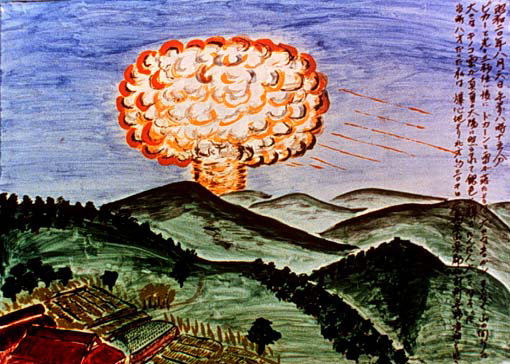
"The source of genius is imagination alone, the refinement of the
senses that sees what others do not see, or sees them differently."
AUTHOR: Eugene Delacroix
 MEANING OF THE QUOTE:
"Artistic genius is a product of a person who

"Artistic genius is a product of a person who
perceives the world differently then the average."
COMPOSER


DIES IRAE
 It has much in common with that work, though
COMPOSER
PENDERECKI

DIES IRAE
AUSCHWITZ ORATORIUM
 |
| Old Dies Irae chant in Medieval Style |
DIES IRAE
AUSCHWITZ ORATORIUM
Lamentatio (Part 1/2)
AUSCHWITZ ORATORIUM
Lamentatio (Part 1/2)
 |
| Stained Glass Window in Auschwitz, 1977 |
DIES IRAE
AUSCHWITZ ORATORIUM
Lamentatio (Part 2)
AUSCHWITZ ORATORIUM
Lamentatio (Part 2)
 |
| http://www.abitoffthetop.com/blog-articles/remembering-the-holocaust-through-fact-and-fiction/ |
DIES IRAE
"DAY OF WRATH"
Gregorian Chant
"DAY OF WRATH"
Gregorian Chant
http://www.youtube.com/watch?v=Dlr90NLDp-0
http://diesirae.nikkojazz.fr/les-origines/le-chant-gregorien-ou-plain-chant
http://diesirae.nikkojazz.fr/les-origines/le-chant-gregorien-ou-plain-chant
 |
| Collective chanting from large-format books stationed on lecterns has been recorded in a number of medieval illuminations and paintings. |
The Dies Irae is a mid thirteenth century
hymn of singular awe and piety customarily
sung as part of the Requiem Mass (the
mass said for the repose of the deceased)
and is commonly attributed
to the authorship of Friar
 |
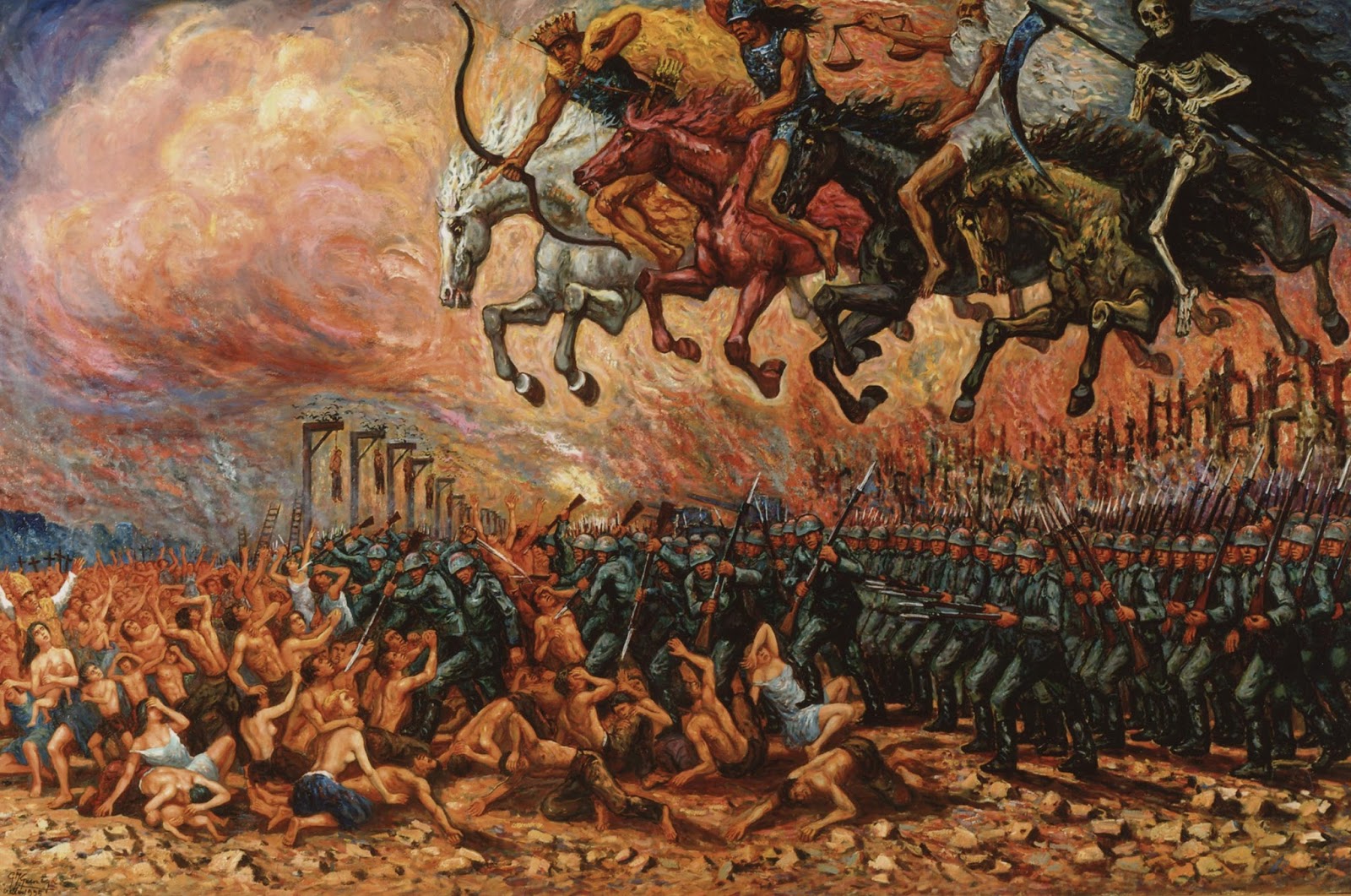
AUSCHWITZ ORATORIUM
Apocalypsis (1/2)
 |
David Olère: Unable to Work
Inability to work was often an immediate death sentence.
In the background of this painting, smoke rises from the crematorium to form the SS insignia. |
DIES IRAE
AUSCHWITZ ORATORIUM
Apocalypsis (2/2)
 |
| Anselm Kiefer: Eisen-Steig, 1986 |
AUSCHWITZ ORATORIUM
Apotheosis: End


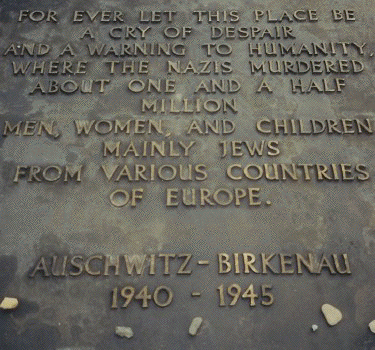
Auschwitz, Polish Oświęcim, also called
Auschwitz-Birkenau, Nazi Germany's largest
and best-known concentration camp and
extermination camp. Located near the
industrial town of Oświęcim
in southern Poland, Auschwitz was
actually a network of three camps in
one: a prison camp, an extermination camp,
and a slave-labor camp. Some prisoners
were also subjected to barbaric
medical experiments led
 |
| Southern Part of Poland near Krakow and between Krakow and Warsaw, Poland |
actually a network of three camps in
one: a prison camp, an extermination camp,
and a slave-labor camp. Some prisoners
were also subjected to barbaric
medical experiments led
 |
| Josef Mengele |
(1911-79). During World War II
(1939-45), more than 1 million people,
by some accounts, lost their lives at
Auschwitz making it the most lethal of
the Nazi extermination camps thus Auschwitz
has become the emblematic site of the “final
solution,” a virtual synonym for the Holocaust.
 |
| Judith Dazzio: Holocaust Prisoners Shown at Birkenau Death Camp Each row shows the prisoners losing more and more life. |


ARTICLE FROM:
DIES IRAE
AUSCHWITZ ORATORIUM
A memorial to the victims at Auschwitz,
Dies Irae allows the singers and players
to improvise according to their talents and
abilities. The chorus recites words, rather
than singing them, and the instruments
are the framework for the rhythm and
pitch. It was first performed on the
grounds of Auschwitz in 1967.
 |
| International Monument at Auschwitz II Birkenau, Unvailed in 1967 This memorial was originally called the International Monument to the Victims of Fascism in Birkenau |
Penderecki composed Dies Irae (also known
as Auschwitz Oratorio) after the successful

it is on the whole a less impressive achievement.
The text draws on various literary sources: Psalm 116,
 |
| Michelle Greene Wheeler: Psalm 116-2 |
 |
The Apocalypse, Frontispiece, Book of Revelation,
Bible of San Paolo fuori le Mura, 9th century
|
 |
| http://www.amazon.com/The-Orestes-Plays- Aeschylus-Agamemnon/dp/0452011663 |
as well as poems by Broniewski, Aragon, Rózewicz
and Valéry. (All the contemporary texts are translated
into Latin while the Aeschylus fragments are sung in
Greek.) The scoring is for very substantial orchestra
with a large percussion section, though without violins,
violas and clarinets, the latter being replaced by
saxophones. The choral writing often uses divisions
(up to 24 parts at times) and mixes song, speech and
chant with a variety of unusual vocal effects, as it did
in the masterly St. Luke Passion. Dies Irae may well
be an occasional piece, but it is nevertheless a