Showing posts with label hymn. Show all posts

Thursday, November 24, 2016

SOME MUSIC FOR THANKSGIVING


Georges Louis Leclerc, comte de Buffon, 
Histoire naturelle générale et particulière (Oiseaux), 
1799-1808
Since 1947, the National Turkey Federation (NTF) has
presented the President of the United States with a live
turkey and two dressed turkeys in celebration of 
Thanksgiving. The annual presentation of the National
Thanksgiving Turkey to the President has become a
traditional holiday ritual in the nation's capital, signaling
the unofficial beginning of the holiday season and providing
the President an opportunity to reflect publicly on the meaning
of the Thanksgiving season. After the ceremony, the live bird
retires to a historical farm to live out the rest of its years.
The Wild Turkey by Audubon
American Country Music and
Hymn and Fuguing Tune No. 2
by Henry Cowell
Henry Cowell
Chester Overture for Band
by William Schuman
William Schuman
Chester is the third movement of a piece
on a book of tunes written by William Billings
during the American Revolutionary War.
Chester begins with a march that was played by the
Continental Army and sung around the campfire:
Chester: America's first unofficial National Anthem
It was written in 1770 and revised in 1778 and was
 second in popularity only to "Yankee Doodle."
Let tyrants shake their iron rod,
And slavery clank her galling chains,
We fear them not, we trust in God,
New England’s God forever reigns.
The foe comes on with haughty stride,
Our troops advance with martial noise,
Their vet’rans flee before our youth,
And gen’rals yield to beardless boys.

Schuman then transports this hymn to the 20th
century, by altering its rhythmic and harmonic
structure until it is barely recognizable. In the
end, the musical battle is won by tonality as the
march reappears in its original form.

William Schuman: Composer Portrait
Grandma Moses: Catching the Thanksgiving Turkey, 1943
Johann Wenzel Peter (1745-1829): Turkey 
New World Symphony
By Antonin Dvořák
George Szell, Conductor
Cleveland Orchestra

http://www.youtube.com/watch?v=0MLvIGHCUAg#t=1173
Audubon's painting of a turkey hen with her poults
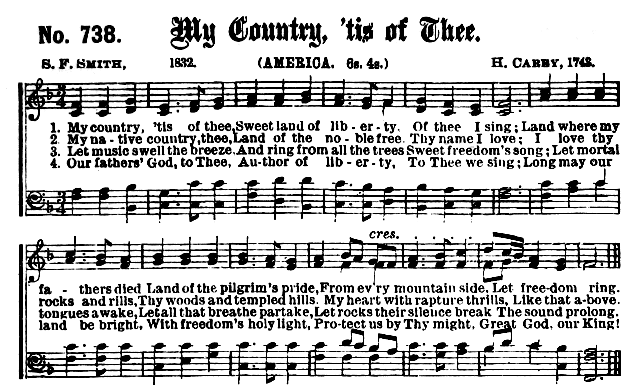
Variations on 'America'
"The President's Own" United States Marine Band
Timothy Foley, Director
Transcribed by William E. Rhoads
from William Schuman's orchestration of
E. Power Biggs's edition of
Ives's variations for organ, S140.
https://www.youtube.com/watch?v=hs0
VjhNWqn8&list=RDhs0VjhNWqn8#t=0
Symphony on a Hymn Tune
By Virgil Thomson
James Sedares, Conductor
New Zealand Symphony Orchestra
The Symphony on a Hymn Tune was completed
in 1928. There are actually at least a couple of
hymns that surface throughout the piece, the main
one being a Scottish melody that is commonly
associated with the text for
You can also hear "Jesus Loves Me."
Jennie Augusta Brownscombe: The First Thanksgiving, 1914

Tuesday, March 10, 2015

TUESDAY, MARCH 10, 2015

QUOTE:
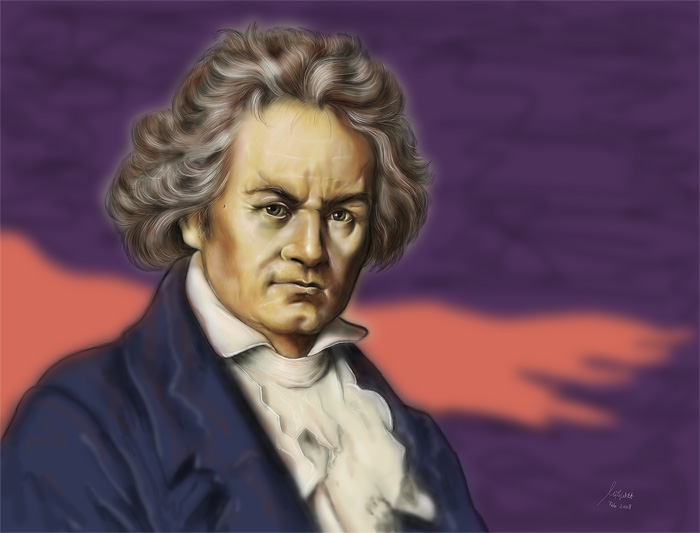
"Everything will pass, and the world will perish
  but the Ninth Symphony will remain."
AUTHOR: Ludwig Van Beethoven
MEANING OF THE QUOTE:
"Good art will outlast the generations
  and continue to be popular."


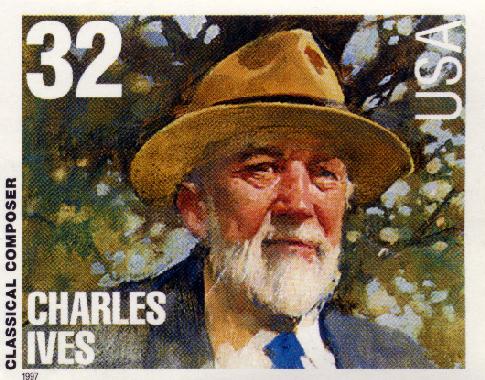
COMPOSER
IVES
HOLIDAYS SYMPHONY
HOLIDAYS SYMPHONY I:
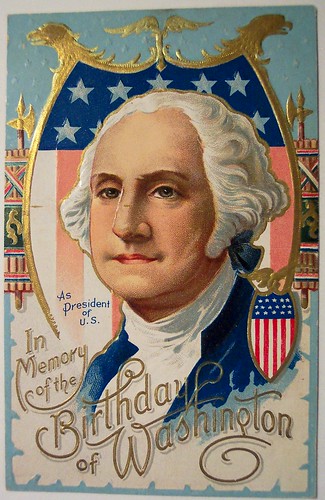
WASHINGTON'S BIRTHDAY
Michael Tilson-Thomas
San Francisco Symphony

https://www.youtube.com/watch?v=zyjIuPiKhsQ
HOLIDAYS SYMPHONY II:
DECORATION DAY
Michael Tilson-Thomas
San Francisco Symphony

https://www.youtube.com/watch?v=n21PsFsL_Gw
HOLIDAYS SYMPHONY III:
FOURTH OF JULY
Michael Tilson-Thomas
San Francisco Symphony
Childe Hassam: The Fourth of July, 1916
HOLIDAYS SYMPHONY IV PART 1:
THANKSGIVING and
FOREFATHERS' DAY
Michael Tilson-Thomas
San Francisco Symphony

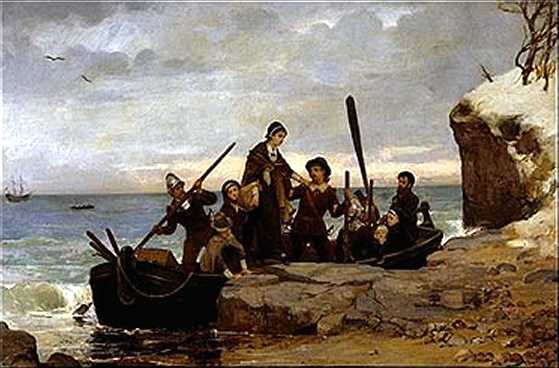
Henry A. Bacon: The Landing of the Pilgrims, 1877
HOLIDAYS SYMPHONY IV PART 2:
THANKSGIVING and
FOREFATHERS' DAY
Michael Tilson-Thomas
San Francisco Symphony
Thanksgiving and Forefathers' Day was the first
movement sketched of the four separate orchestral
movements of "A Symphony: New England
Holidays," and the last to be performed.

Its title refers to two American holidays: the national
Thanksgiving Day, commemorating the first harvest
of the Plymouth Colony,
Historic Painting of the Famous First Thanksgiving
Feast of the 1621 Harvest Celebration at Plymouth
That Included the English Colonists and the Wampanoag Indian
shttps://prezi.com/uusulq2lpy4g/plymouth-presentation/
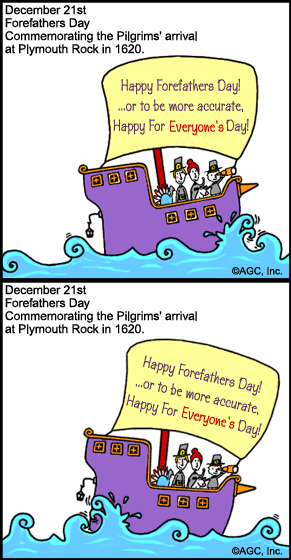
and Forefathers' Day, commemorating the
landing of the Pilgrims at Plymouth in 1620
http://fineartamerica.com/featured/plymouth-rock-1620-granger.html
and traditionally observed in New England in December.


The design of "Thanksgiving" can be represented as
A-B-A with a very brief introduction and coda.
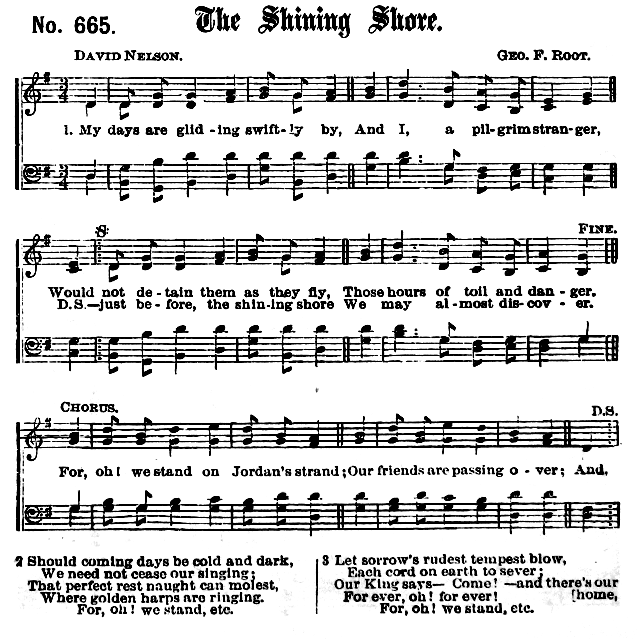
The B section consists of three versions of
George F. Root Image
George Frederick Root
The three variants themselves constitute a small a-b-a,
with soft renditions of the hymn enclosing a more
jagged and louder one.  The A section returns, builds
grandly, and culminates with the choir singing the
Thanksgiving hymn "O God, Beneath Thy Guiding
Hand" to the tune called "Duke Street,"
http://www.hymnary.org/hymn/SH1912/10
"God! Beneath thy guiding hand,
Our exiled fathers crossed the sea,
And as they trod the wintry strand,
With prayer and praise
they worshipped Thee.
The author of the hymn was
Leonard Bacon,
who had been the minister
at Center Church

from 1825 until 1866.

Ives has us imagine
"a Puritan band marching
out of view and hearing,"
and then the music, full of bells
and chimes, fades into silence. 

Wednesday, February 11, 2015

WEDNESDAY, FEBRUARY 11, 2015

QUOTE:
"To send light into the darkness of men's
  hearts-such is the duty of the artist."
AUTHOR: Robert Schumann

MEANING OF THE QUOTE:
"Art is created to make a better world."


COMPOSER
HAYDN
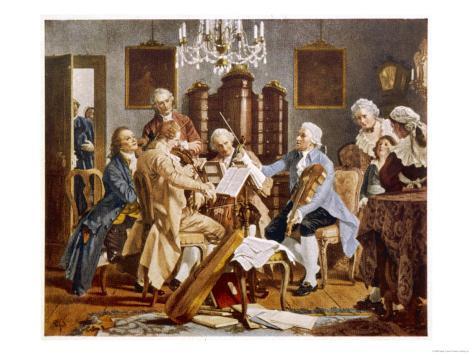
Haydn and Companions Perform a String Quartet
EMPEROR QUARTET in C MAJOR
HOB lll. 77, OP. 76 NO. 3
Movement 1
Allegro
Kodály Quartet
Emperor 1st movement, 1st theme
Emperor 1st movement, 2nd theme

EMPEROR QUARTET in C MAJOR
HOB lll. 77, OP. 76 NO. 3
Movement 2
Poco Adagio, Cantabile
Kodály Quartet
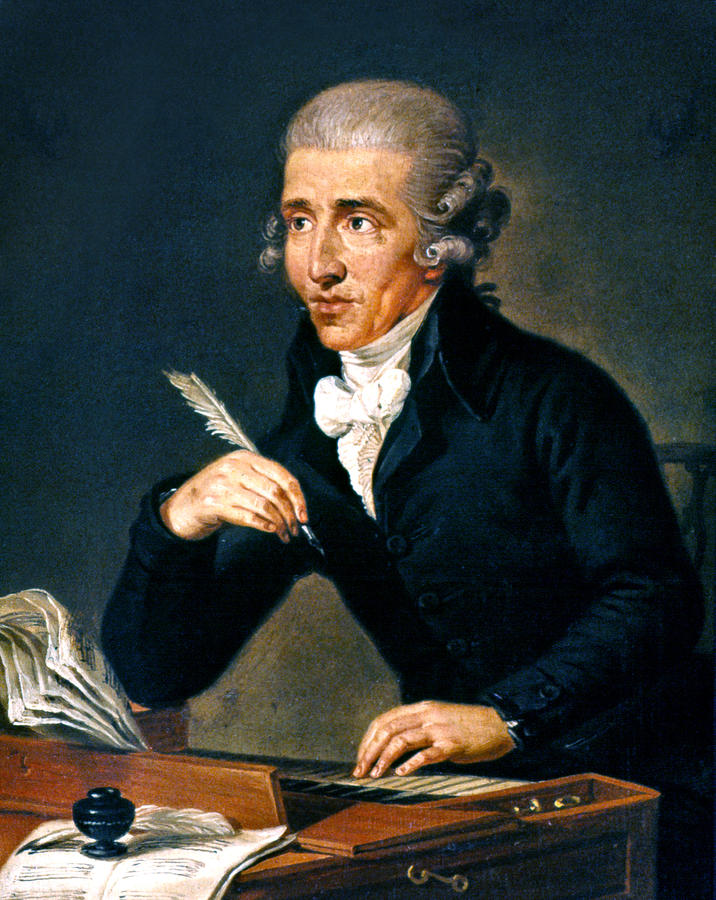
Joseph Haydn, Composer
(It comes from the 3rd movement of Haydn's Kaiser Quartet)

EMPEROR QUARTET in C MAJOR
HOB lll. 77, OP. 76 NO. 3
Movement 3
Menuetto Allegro
Kodály Quartet

https://www.youtube.com/watch?v=k2Mm_g63UP8
Emperor 3rd movement, 1st theme
Emperor 3rd movement, 2nd theme

EMPEROR QUARTET in C MAJOR
HOB lll. 77, OP. 76 NO. 3
Movement 4
Finale: Presto
Kodály Quartet
Emperor 3th movement, main theme


Emperor Quartet Hob. III:77 
Composed 1797
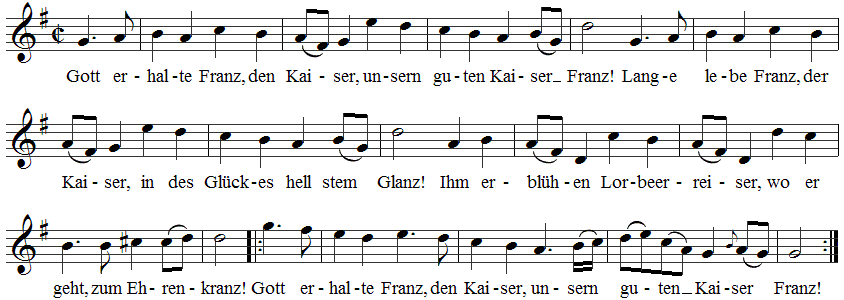
The Emperor Quartet derives its name from the
set of four variations in the second movement
on the so-called Kaiser Hymn.
Glorious Things of Thee Are Spoken
St. Thaddaeus' Episcopal Church Choir
http://musicofyesterday.com/sheet-music-g/glorious-things-thee-spoken/

This quartet fell out of favor during
World War II since the song was also

Nazi Germany National Anthem
(A Part of a Double Anthem)
During WW II (1933-1945)
http://germanenglishwords.com/rlgd.htm
but Haydn’s grace can’t be kept
down by a historical anomaly.
00:00 THEME A
00:15 THEME A
00:29 THEME B
00:39 THEME C
01:05 THEME C
01:24 VARIATION I
02:31 VARIATION II
03:50 VARIATION III
05:12 VARIATION IV 
After a chorale setting of the tune, the first
variation is for the two violins, with the first
spinning a series of virtuosic arpeggios around
the melody in the second. The cellist takes the song in
the next variation with the other instruments decorating
and providing harmony, and the third features the
viola with the melody against a series of syncopation
from the other instrumentalists. The final variation
hints at E minor, before ending somberly and
quietly in G major.
Haydn Discovery
Op. 76, No. 3 "Emperor" Quartet
Geoff Nuttall and his St. Lawrence String Quartet
colleagues will reveal Haydn’s genius by
unpacking this masterpiece via "active listening."
Recorded by Da Camera of Houston, September 27, 2014


The quartet opens with a spirited, and
traditional, sonata-form movement. The third
movement’s Menuett takes a lively chromatic
trip, especially in the middle Trio section, and
the closing movement summons some of the
virtuosic fiddle work of the second movement’s
second variation. If anything, it’s even fiery
here, punctuated by several violent outbursts.
MARC GEELHOED ©2011