Everything music from a perspective of a public
school music teacher with subject integration
(especially art, history, and literature) as a focus
to help teach the Common Core Curriculum.
A tuning fork serves as a useful illustration of how a vibrating object can produce sound. The fork consists of a handle and two tines. When the tuning fork is hit, the tines begin to vibrate back and forth several hundred times per second. The back and forth vibration of the tines produce disturbances of surrounding air molecules. Often, the vibrations are so fast that they're not visible to the human eye. Experimentally this can be viewed by dipping a humming tuning fork into a cup of water; it will kick up a surprisingly large jet of water.
Tuning fork vibrations in super slow motion:
The speed of a tuning fork's vibrations is known as its frequency, a quantity measured in hertz (Hz), or vibrations per second.The faster a tuning fork's frequency, the shorter the length of the tuning fork tine and the higher the pitch of the note it plays because it has less distance to move. An example: a very high sound may vibrate at 4,000 Hz. and a very low sound vibrate at 28 Hz. It is the same principle as strings on a guitar; a tight string vibrates quickly and a loose string takes longer to shudder back and forth, resulting in a lower tone.
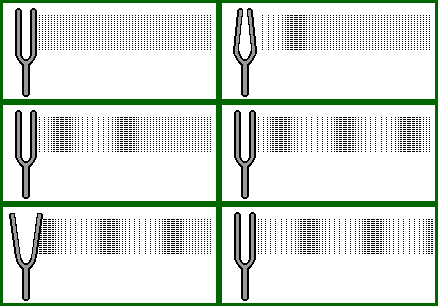
During the vibration, as a tine stretches outward from its usual position, it compresses surrounding air molecules into a small region of space creating a high pressure (compression) region next to the tine. As the tine then moves inward from its usual position, air surrounding the tine expands producing a low pressure (rarefaction) region next to the tine. As the tines continue to vibrate, an alternating pattern of high and low pressure regions are created. These regions are transported through the surrounding air, carrying the sound signal from one location to another forming a sound wave.
The vibration of 440 cycles/sec causes compression and rarefaction of air molecules
generating sound waves.
The "tuning fork" was invented by John Shore, English musician to the royal court in 1711 and had a pitch of A423.5. The numbers underneath the musical notes represent the Hertz (Hz) or cycles per second of the sound wave made when the fork is vibrating.
Standard Pitch or Concert Pitch is a universal frequency or note that all musical instruments are tuned to. Today's standard pitch is A440 or C523.3 and this enables musicians to play instruments together in harmony, without clashing pitches. A tuning fork is normally used to set the pitch. Pitch pipes and electronic tuning forks can also be used, but are not as common
GENERAL MUSIC PERIODS 2, 3: COMPOSER: CHOPIN/Nocturne Eb Major Opus 9-2
Played by Rachmaninoff
OBJECTIVE: Rules and Procedures/Introduction to Solfege 1. Work on "Silly Test"of class behavior rules during roll 2. Seating Charts: Students are allowed to choose their own seats as long as they can maintain proper class behavior 3. Solfege Roll a. What is solfege? Explanation, demonstration, Curwen hand signals http://web.ku.edu/~cmed/acdapres/curwendiatonic.html b. Solfege (Sol-Mi the natural chant or interval of childhood) Introduction (each student sings and hand signs their name in solfege using Sol-Mi) c. "Jorge the Gila Monster"(http://www.proteacher.net/discussions/showthread.php?t=112400 ; http://openlibrary.org/books/OL7814091M/Any_Turkey_Can_Tango) solfege movement activity with recording 4. "Silly Rules" discussion of answers(to be finished tomorrow)
GENERAL MUSIC PERIOD 6: 1. Students invited to the band teacher's class (Mr. Roa) for demonstration and discussion of different instruments. (To be finished tomorrow.) 2. Demonstration of accordian, violin, and trumpet. BEGINNING VIOLIN PERIOD 5: OBJECTIVE: Rules, Grading and Class Behavior Expectations/Issuing and Sizing of Instruments 1. Review Rule Sheets and Grading Expectations 2. Collect Signed Rule Sheets 3. Sizing of instruments 4. Starting to issue instruments (to continue tomorrow)
ADVANCED VIOLIN PERIOD 4: OBJECTIVE: Set-Up and Put Away Procedures/Open String Bow-Tone Warm-Ups 1. Procedures on how to set-up and put away instruments properly (explained and rehearsed) 2. Two students chosen to help keep violin storage closet properly organized 3. Collect signed rule sheets and loan forms 4. Open string tone review using the bow: upper half (mark bows middle and tip as needed) .....a. Articulated sounds of separate bows (listening to identify the proper sound then practice making the sounds) .....b. Separate Bows [Upper Half (UH)] 4x each string/8x each string .....c. Explain these different types of bowing: bow proportioning (using different amounts of the bow for fast and slow notes) versus bow speed (using the same amount of bow for notes whether slow or fast) .....d. Separate Bows (UH) for bow speed "My Sis-ter Mar-cy" rhythm (slow-fast-fast-slow-slow) on each string 2x 5. For self tuning check out this site:http://www.get-tuned.com/violin_tuner.php
OBJECTIVE: Introduction to "General Music Class" and "Recorder Care Procedure Rules." 1. Entering room procedures ....a. Handout is passed out. Contents: seating chart, rules to be gone over and later to be signed, "Behavior Warning" sheet and "Behavior Multiple Choice 'Silly' Test" ....b. Backpack placement in back of room at designated area ....c. 2 pencils brought to seat ....d. Students start "Silly Test" (to be continued tomorrow) while teacher takes role. 2. Teacher introduction 3. Class Overview 4. Bathroom/Water Directions (more of rules discussed tomorrow) 5. Use of a "piggy back" song to help learn recorder rules. a. Beat b. Rhythm c. Mathematical patterns of the beat d. Body Percussion (snap, head tap, and "patsch" thighs) 6. Exit room procedures BEGINNING VIOLIN PERIOD 5: OBJECTIVE: Introduction to violin class 1. Entering room procedures ....a. Handout is passed out. Contents: seating chart and rules to go over and to then be signed (to be continued tomorrow) 2. Teacher introduction and philosophy 3. Exit room procedures
ADVANCED VIOLIN PERIOD 4: OBJECTIVE: Overview of plans for the year 1. Seating arrangement expectations 2. Go over and play samples of some of the music chosen for the year 3. Take out violins and make sure cases are labeled 4. Pass out loan forms to get signed. 5. Pass out class rule sheets (review as needed) to be returned signed. 6. Preparation so everyone to begin playing tomorrow. 7. Explain how to tune a violin and everyone practices tuning on their instrument.


 This example above shows you which fine tuners to use