PIZZICATO

Pizzicato (pronounced 'pitzi-KA-toe') from the Italian:
pizzicato, roughly translated as plucked) is a playing
technique that involves plucking the strings of a bowed
string instrument with the fingers, rather than using the
bow. The exact technique varies somewhat depending
on the type of stringed instrument played, the style of
the music, and the effect wanted. The technique of
pizzicato (or "pizz" as an abbreviation of the term)
produces a very different sound from bowing; short
and percussive rather than sustained. A direction
given to players to return to the use of the bow is
indicated by the term "arco."
RIGHT HAND PIZZICATO

To play pizzicato or pizz (pronounced 'pitz') is to
play the violin with one's finger while the violin
remains under the player's chin. To do this, (the
most traditional method) the player would quickly
place the frog of the bow in the palm of his/her
right hand (the bow hand), place the pad of the
right thumb (bow thumb) against the corner of
the fingerboard, and pluck the string firmly but
gently with the right index finger. The finger
should be plucking the strings between the
bridge and the end of the fingerboard, where
the bow usually plays. This technique is called
the "right hand" pizzicato and it is the pizzicato
most generally used.
Less used is the "left hand" pizzicato (a technique
which began to be used during the classical late
romantic period) which is when the strings are
plucked firmly with the fingers on the same
hand that presses the strings down. If reading
musical notation, this is usually indicated by a
"+" sign above the note.

Quite often this particular
form of pizzicato is meant
to be used at the same time
the player is using the bow.
When a player switches from
arco (bowing) to regular pizzicato,
the player normally requires a short
pause to switch his or her bowing
hand into pizzicato position and pluck
the string. With left-hand pizzicato,
though, a string player can play a
pizzicato note immediately following a
bowed note; thus, left-hand pizzicato
provides a means to play bowed tones
and pizzicato tones simultaneously or
in alternation during rapid passages.
The string on which the note is played
may be either open or stopped (fingered);
the only requirement for using the technique
on a stopped string is that the finger stopping
the string be lower than the finger plucking the string.
Left-hand pizzicato appears most prominently
in violin "virtuoso pieces" such as Pablo de
Sarasate's Zigeunerweisen
and Paganini's 24th Caprice.
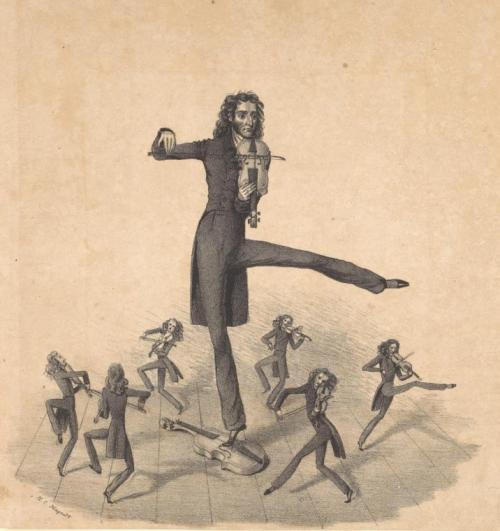
This violin technique was first introduced and
made famous by the famous Italian violinist:
Niccolo Paganini (1782-1840).

He was able to execute the finger movements
easier than most probably due to a medical
syndrome he had which enabled more
flexibility in his fingers and wrist.

In an article published in JAMA dated 2 January,
1978, Dr. Myron R. Shoenfeld advances the theory
1978, Dr. Myron R. Shoenfeld advances the theory
that Paganini was born with Marfan's Syndrome:
"The long, sinuous, hyperextensible fingers of his
left hand gave his fingers an extraordinary range
of motion and freedom of independent movement
on the fingerboard, while the laxness of the wrist
and shoulder joint of his right upper extremity gave
him the pliancy required for masterful bowing."

 |
| http://www.kiptonart.com/artists/nikolai-oskolkov/ |
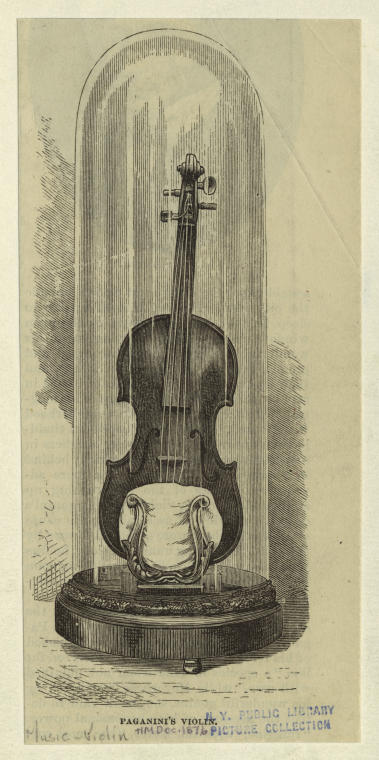 |
| Paganini's Violin |
 |
"The Cannon" was Paganini’s cherished instrument
which has a distinctive depth and resonance where
its power shocks and awes listeners to this day. It is
on display in Genoa and is occasionally loaned out
for public recitals.
|

Paganini Links:
http://classical-composers.suite101.com/
article.cfm/niccolo_paganini_superstar
http://en.wikipedia.org/wiki/Niccol%C3%B2_Paganini
http://www.paganini.com/nicolo/nicindex.htm
http://w3.rz-berlin.mpg.de/cmp/paganini.html
http://www.google.com/search?q=Paganini&hl=en&rlz
=1I7GGLL_en&tbs=tl:1&tbo=u&ei=KvxfS_fYJJLiswOjp-3ACw&sa
=X&oi=timeline_result&ct=title&resnum=11&ved=0CDgQ5wIwCg
http://www.ppmusic.com/music/comp07.htm
http://www.thirteen.org/publicarts/violin/paganini.html
http://www.findagrave.com/cgi-bin/fg.cgi?GRid=3565&page=gr
http://musiced.about.com/od/romanticperiod/p/paganini.htm
http://www.8notes.com/biographies/paganini.asp
http://www.guitarramagazine.com/NicocoloPaganini
http://www.allmusic.com/cg/amg.dll?p=amg&sql=41:4704~T1
http://www.lessontutor.com/bf12.html
http://www.allthingsstrings.com/Technique/VIOLIN/
3-Ways-to-Get-a-Hand-on-Your-Pizzicato-Technique
http://www.youtube.com/watch?v=LtvKJaItYmA&feature=related
http://www.youtube.com/watch?v=DFikzos8Iao&feature=related
http://www.youtube.com/watch?v=O9GN2cIOiVU&feature=related
http://secretlyido.blogspot.com/2011/01/deal-with-devil.html
PIZZICATO LINKS
http://en.wikipedia.org/wiki/Pizzicato
http://www.npr.org/templates/story/story.php?storyId=860282
http://www.theviolinsite.com/pizzicato.html
http://www.answers.com/topic/pizzicato
http://www.violinfromscratch.com/home/beginners-violin
-lessons/holding-the-violin-and-playing-pizzicato
http://simple.wikipedia.org/wiki/Pizzicato
http://en.allexperts.com/q/Violin-2164/2009/2/playing-violin-fingers.htm
http://www.youtube.com/watch?v=TroJUuyUP1Y
http://www.violinmasterclass.com/pizzicato_qt.php?video=piz_def1&sctn=Definition
http://www.ehow.com/video_4946766_violin-techniques-left-hand-pizzicato.html
http://www.wonderhowto.com/how-to/video/how-to-practice-intermediate-left-handpizzicato-on-violin-6198/
http://www.wonderhowto.com/how-to/video/how-to-practice-beginner-left-hand-pizzicato-on-violin-6197/
http://violinmasterclass.com/pizzicato_qt.php?video=piz_exer1&sctn=Exercises
http://www.netplaces.com/music-composition/writing-for-strings/pizzicatotechniques.htm
http://www.youtube.com/watch?v=O9GN2cIOiVU
http://askville.amazon.com/Pizzicato-playing-technique-involves
-plucking-strings-string-instrument/AnswerDetails.do?
requestId=61348083&responseId=61676089
http://www.ehow.com/how_15641_play-pizzicato-violin.html
http://en.wikipedia.org/wiki/Pizzicato
http://www.npr.org/templates/story/story.php?storyId=860282
http://www.theviolinsite.com/pizzicato.html
http://www.answers.com/topic/pizzicato
http://www.violinfromscratch.com/home/beginners-violin
-lessons/holding-the-violin-and-playing-pizzicato
http://simple.wikipedia.org/wiki/Pizzicato
http://en.allexperts.com/q/Violin-2164/2009/2/playing-violin-fingers.htm
http://www.youtube.com/watch?v=TroJUuyUP1Y
http://www.violinmasterclass.com/pizzicato_qt.php?video=piz_def1&sctn=Definition
http://www.ehow.com/video_4946766_violin-techniques-left-hand-pizzicato.html
http://www.wonderhowto.com/how-to/video/how-to-practice-intermediate-left-handpizzicato-on-violin-6198/
http://www.wonderhowto.com/how-to/video/how-to-practice-beginner-left-hand-pizzicato-on-violin-6197/
http://violinmasterclass.com/pizzicato_qt.php?video=piz_exer1&sctn=Exercises
http://www.netplaces.com/music-composition/writing-for-strings/pizzicatotechniques.htm
http://www.youtube.com/watch?v=O9GN2cIOiVU
http://askville.amazon.com/Pizzicato-playing-technique-involves
-plucking-strings-string-instrument/AnswerDetails.do?
requestId=61348083&responseId=61676089
http://www.ehow.com/how_15641_play-pizzicato-violin.html
SOME PIZZICATO PIECES TO LISTEN TO
Ludwig van Beethoven
Kreutzer Sonata (1803)(First Movement)
Nathan Milstein, Violin
Georges Pludermacher, Piano
https://www.youtube.com/watch?v=sklCKCE7zLc
Pyotr Ilyich Tchaikovsky
Symphony No. 4 (1877-78)
(Third Movement)
Michael Tilson Thomas, Conductor
San Francisco Symphony
Béla Bartók
String Quartet No. 4 (1927)
(Scherzo: Fourth Movement)
Amadeus Quartet
String Quartet No. 4 (1927)
(Scherzo: Fourth Movement)
Amadeus Quartet
Leroy Anderson
Plink, Plank, Plunk! (1951)
Plink, Plank, Plunk! was known to many in the 1950's as the
Plink, Plank, Plunk! was known to many in the 1950's as the
Mormon Orchestra of Washington D.C.
String Section
String Section
Jazz Pizzicato
Leonard Slatkin, Conductor
Saint Louis Symphony Orchestra
_embedded&v=qDRYX6-Wihc#at=27
Léo Delibes
"Divertissement: Pizzicati"
from Act 3 of the Ballet Sylvia (1876)
Miguel Del Oro Orchestra
"Divertissement: Pizzicati"
from Act 3 of the Ballet Sylvia (1876)
Miguel Del Oro Orchestra
Benjamin Britten
Simple Symphony (1934)
(Second Movement)
Swedish National String Orchestra
Simple Symphony (1934)
(Second Movement)
Swedish National String Orchestra
Ferde Grofe
Trick or Treat
(Halloween Fantasy for Pizzicato Strings)
Andre Kostelanetz, Conductor



.jpg)


.jpg)


.jpg)