Everything music from a perspective of a public
school music teacher with subject integration
(especially art, history, and literature) as a focus
to help teach the Common Core Curriculum.
QUOTE: "Music can noble hints impart, Engender fury, kindle love, With unsuspected eloquence can move, And manage all the man with secret art." AUTHOR: Joseph Addison MEANING OF THE QUOTE: "Music specializes in communicating the deepest feelings of mankind."
COMPOSER MENDELSSOHN
SYMPHONY NO. 4 IN A MAJOR "ITALIAN"
Otto Klemperer, Conductor Vienna Symphony Orchestra
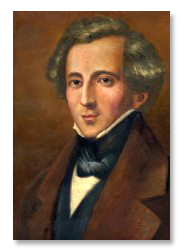
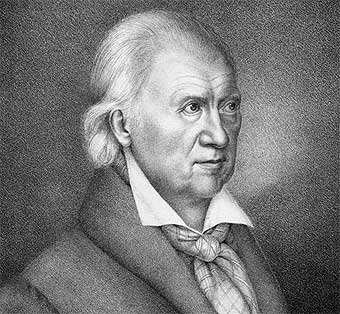
Mendelssohn's parents encouraged their talented young son, but they also wanted him to be a well-rounded adult, with a chance to see and learn from the wider world. Thus, in the spring of 1829, when the composer reached his 21st birthday, his father encouraged (and financed) him to leave Germany on a series of travels, with instructions "to examine the various countries closely and to fix on one where I wished to live." As Mendelssohn later wrote, "I was to make my name and gifts known, and was to press forward in my work." Mendelssohn lived up to his father's wishes. His first journey, to Britain in 1829, resulted in a number of compositions, including the Hebrides Overture (1830), and some sketches for his Symphony No. 3 ("Scottish"), which he later completed in 1842. He made such an impression on the musical scene in London that two generations of English composers were influenced by his example. He soon moved on to the next portion of his journey traveling to Italy in May of 1830 with the urging of his composition teacher, Carl Friedrich Zelter,
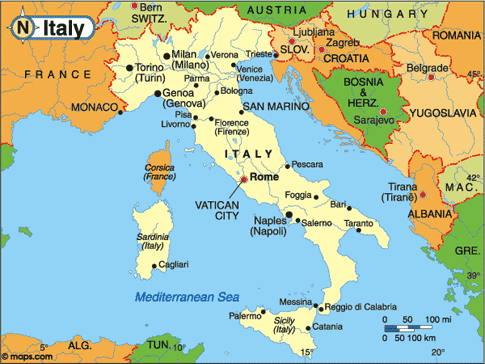
who himself had earlier embarked on a secret and anonymous journey to Italy "to discover myself in the objects I see." Goethe had visited Lake Garda, Verona, Vincenz, Venice, Bologna, Rome, Naples, and Sicily meticulously recording his impressions to later publish them in his "Italian Journey."
for two-weeks in Weimar, and with a copy of the "Italian Journey" in hand,
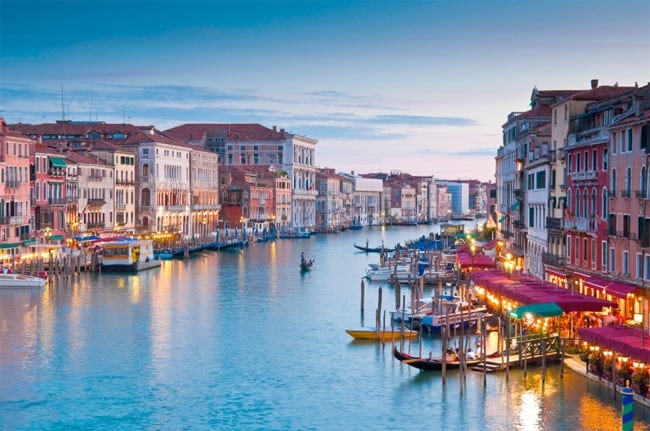
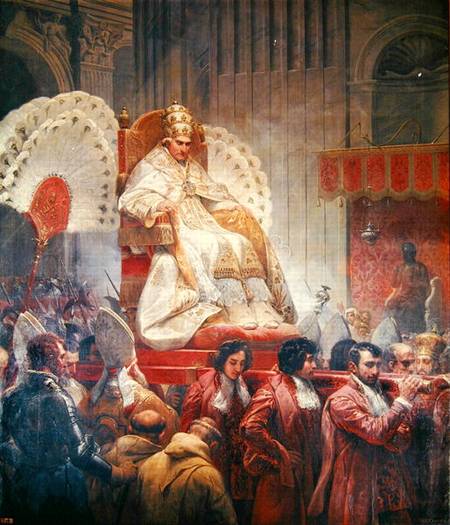
Mendelssohn did much the same. He departed for an extended ten-month pilgrimage to Italy where he made the rounds starting from Venice Arriving in Venice on 10 October 1830, Mendelssohn, enjoying the scenery and the cities immensely, was hardly able to contain his excitement. "Italy at last! And what I have all my life considered as the greatest possible felicity has now begun, and I am basking in it…I do not know where to find sufficient grasp of intellect to comprehend it all properly. I saw the 'Assumption,' then a whole gallery of paintings in the Manfrini Palace; then a church festival in the church where hangs Titian's St. Peter; afterwards St. Mark's!" then working his way south to Rome, stopping in Bologna and Florence along the way. "The whole country" he wrote, "had such a festive air that I felt as if I were a young prince making his entry." Writing to Fanny on February 22, 1830, he reported, "I have once more begun to compose with fresh vigor, and the Italian symphony makes rapid progress; it will be happiest piece I have ever written, especially the last movement." During his stay in Rome, he witnessed the coronation of Pope Pius VIII
and the city's festivities during Holy Week (the week leading up to Easter). From Rome, he went on to Naples and visited Pompeii before returning to Germany through Genoa and Milan. These experiences are felt in this piece as this symphony is not actually about the music of Italy (with the exception of the Saltarello of the final movement) but about Mendelssohn's personal impressions of Italy: Mediterranean sunshine, religious solemnity, monumental art and architecture, open countryside, and the vitality of the people. Not only were his impressions recorded through this music but through his correspondence and also by means of a series of watercolor paintings and sketches he, a decent amateur artist,
created during his travels. Unable to finish the symphony to his satisfaction during his tour, he completed it, after time back at home and a winter in Paris, in Berlin on the 13th of March in 1833 in response to an invitation for a symphony from the London (now Royal) Philharmonic Society. Mendelssohn had just turned twenty-four years old. He conducted the premiere performance himself in London on May 13 of the same year. The work was a tremendous success and even though Mendelssohn described it as "the jolliest piece I have so far written…and the most mature thing I have ever done" he was dissatisfied with the final movement and pulled the symphony from performance a year later, intending to revise it. In 1834, over a year after the work's public premiere, Mendelssohn began extensive revisions on the second, third, and fourth movements. The following year he reworked the first movement, and he was sufficiently satisfied with the result to allow another London performance in 1838. Yet, Mendelssohn still withheld the composition from publication and refused to permit its performance in Germany. He continued tinkering with it until he died in 1847. This final version premiered in Leipzig on November 1, 1849, with Julius Rietz
 MEANING OF THE QUOTE:











.jpg)
.jpg)
.jpg)
0008.jpg)

.jpg)


.jpg)
.jpg)

0008.jpg)
.jpg)


.jpg)
.jpg)
.jpg)
0008.jpg)


.jpg)
.jpg)
0009.jpg)

.jpg)