Showing posts with label Colonial American Music. Show all posts

Sunday, October 6, 2013

OPEN STRING MUSIC COMPOSED BY BENJAMIN FRANKLIN

Quartetto for Three Violins and Cello

Here are some articles from the Internet 
that explain about this unique music:


American readers of this blog need no introduction to Benjamin Franklin. For others, a reminder: His face is on the US $100-bill. Franklin was one of the Founding Fathers of the United States, and one of the most extraordinary geniuses ever known. Born into the family of a Boston candle maker, he was a writer, scientist, diplomat, entrepreneur, and, most interestingly for us – a musician.

Franklin played harp and guitar, and invented a version of the glass harmonica that nested the glasses and made the ‘instrument’ much easier to play.

And he wrote at least one string quartet! One is still lost, but there is a manuscript of a string quartet bearing his name as the composer is in the Bibliothèque Nationale, Paris.

It is a very experimental piece, showing off not just the musician but the scientist in him.

It’s written for three violins and cello rather than a standard quartet. The really interesting aspect is that all the instruments use ‘scordatura’. This means the strings are deliberately tuned to pitches other than normal tuning.

This enables the piece to be played entirely on open strings only, so the left hand is not required to touch the strings on the fingerboard at all. Only the right hand holding a bow is required to play the piece. Beginners could play the piece, though I doubt that was Franklin’s prime intention. More likely he was challenging himself to come up with the mathematical ingenuity required to devise the tuning system.

So what does it sound like?

The very first recording was made by the Kohon Quartet in about 1969. You can hear samples and purchase it here. (Note: it’s the last quartet on Disc 1 – it’s not very clearly labelled)

The video above is of a student quartet playing it. I wish the audio quality were better but you get an idea of the piece.

Below is a much better recording (transfered from LP), but the piece has clearly been rewritten for normally-tuned instruments. It defeats the purpose, in my opinion, but you can hear the tunes Franklin wrote.

- See more at: http://forgottenstringquartets.com/site/1750-1800/benjamin-franklin-quartet-for-3-violins-and-cello/#sthash.ejMejOLB.dpuf


About Ben Franklin
Benjamin Franklin was a fine amateur musician who was very knowledgeable in the history, theory, and harmony of music. He studied music as a Science, and practised it as an Art. It is said that he could play violin, cello, harp, and guitar. When Franklin drew up plans for his home in Philadelphia, he specified a particular room for music and entertainment. It was on the third floor, painted blue, and became know as the Blue Room. It housed his musical instruments which included the Armonica, a viola da Gamba, a Welsh harp, a harpsichord and a set of tuned bells to help him tune his harpsichord which he said "when properly tuned, it's music exceeds what can be produced by common instruments, but (without the bells) too useless for me."


He loved to play duets with his daughter, Sally, she on the harpsichord and he on his "beloved Armonica." Of all the things Franklin accomplished, the Armonica gave him his greatest personal joy. Franklin loved to play Scottish songs as he felt their beauty lay in their simplicity.


Franklin loved to sing and often joined friends in evenings of song. He felt singing was a melodious way of speaking. He wrote lyrics to many songs which included "My Plain Country Joan", a song that extolled the virtues of his wife, Deborah.


Franklin attended many concerts in his lifetime, many in America but more in Europe where he spent over 28 years as Colonial representative in England and then in France as Ambassador. In fact, while in England in 1759, he attended the last concert of The Messiah conducted by Handel just eight days before the death of the composer. In his diary, Franklin wrote that he saw "the sublime old man, one of the sturdiest characters of modern times, led to the organ for the last time to conduct one of his works."


Another Version:

I. March

II. Menuetto


Use this document to tune your instruments 
Quartetto / a/ 3 violini / con / Violoncello / Del Sig Benjamin Franklin 


Scholars revive debate on whether Ben Franklin composed tongue-in-cheek string quartet
July 30, 2006 12:00 am
By Andrew Druckenbrod / Pittsburgh Post-Gazette
In addition to all his other interests, Franklin had a passion for music.

Mozart, Beethoven, Haydn ... Benjamin Franklin? Born 300 years ago, Franklin (1706-90) had many talents: author, printer, statesman, diplomat, scientist and inventor. Although it is lesser known, the Philadelphian also had a passion for music.

Franklin played the harp, the violin and the guitar. He printed hymns, wrote a treatise on musical aesthetics, invented a four-sided music stand and attended many concerts. His most significant contribution is the invention of an improved, mechanical version of water-filled musical glasses popular at the time, known as the armonica, or glass harmonica.

Franklin assembled glass bowls of different size on a horizontal rod, which was turned by a foot pedal while the player ran moistened fingers across their edges to create tones. "The invention achieved a certain popularity in America but exercised far more influence in Europe," writes the New Grove's Dictionary of Music and Musicians. Even Mozart wrote for it.

But was Franklin also a composer? A Pennsylvania professor of music thinks so, and he wants to add that vocation to the Founding Father's impressive resume.

Kenneth Sarch, director of orchestral activities at Mansfield University in Tioga County in north-central Pennsylvania, has revived an old debate on whether Franklin wrote a most unusual string quartet while living in Paris around 1778. If it were true, it would add even more richness to the legend of America's celebrated polymath in this, the tricentennial of his birth.

The five-movement quartet is written for the unusual arrangement of three violins and one cello, rather than the format of two violins, viola and cello that had become somewhat standard for string quartets by the late 18th century. But that feature is tame compared to the F-major quartet's most bizarre quality: "[It] calls for all four string instruments to retune to different pitches, creating 16 notes to be played without left-hand fingering, using only the bow," says Sarch, who is creating a performing edition for student orchestra.

This technique is known as scordatura, a retuning of a string instrument to lend different tone and color to the strings (usually to make them sound thinner or brighter). The most famous examples come from Romantic composers Mahler and Saint-Saens. They applied the technique to the violin for supernatural flavor in Symphony No. 4 and "Danse Macabre," respectively. However, even these composers would have thought it unusual to employ scordatura so that no fingering is required. If anything, composers tend to avoid open strings because the timbre is hollow and the player cannot use vibrato.

Just as strange are the quartet's various melodies, which are passed, note by note, around the four players. "If you can imagine four players with four hand bells having to ring one note at a time in different rhythms, that is what this is," says Sarch. Typically, of course, melodies are played on one instrument before they travel to another.

On top of that, the particular 16 notes don't allow for the music to change key or develop harmonically. Says Sarch, "There is no other quartet like it in the history of music that I know of."

Clearly, something fishy is going on here. This is no ordinary piece written for court or concert.

"No serious composer would tolerate such restrictions unless done with tongue in cheek, simply as a musical joke," wrote W. Thomas Marrocco in a seminal study of the quartet in 1972.

This assertion, one of the few issues of consensus among scholars, makes it unlikely that Haydn, Pleyel or Ferrandini composed the work, even though the quartet is attributed to these three well-known composers in various copies peppering Europe. Franklin is given credit for the work in what may be the earliest manuscript, one found in Paris, but it is not in his hand. So it is up to conjecture whether he wrote it.

While Franklin is known to have penned a drinking song in his youth, "there is no evidence that he learned to read music," says Bruce Gustafson, a music professor at Franklin & Marshall College.

Similarly, Franklin frequented the Parisian salon of Mademoiselle Brillon, an accomplished amateur musician. Her soirees would have been the perfect opportunity for Franklin to show off such a quartet, performed by the dilettantes at these parties. However, "there is no mention of it that I have found in the abundant correspondence between Franklin and Mlle. Brillon," says Gustafson, who has done several studies of the Parisian socialite.

The best evidence may be our general knowledge of Franklin. He possessed a genius for puzzles, inventions, chess and mathematics. "Franklin was brilliant and inventive and loved cracking problems and puzzles, so he could well have figured out how to combine some sounds on stringed instruments," says Gustafson.

Franklin's musical beliefs were strong, too, outlined in a short treatise on music and several letters. He preferred clear and simple music that didn't distort the words, and he went so far as to criticize Handel's opera "Judas Maccabaeus" for its misplaced accents, repetition and "screaming."

These facts, combined with Franklin's known predilection for musical gatherings while residing in Paris, would suggest he would have had good reason to impress guests with such a parlor game of a work as the quartet. "It is part of the amusement, to make a piece with this idea," says Sarch. "I can imagine him sitting around in the evening with a couple of his friends trying to make music doing this."

Since no other composer took credit for the piece or has had it attributed to him by later scholars, the quartet may well have been by Franklin. "The only thing in favor of the Franklin attribution is that it was obviously not written by a musician," says Gustafson.

To this point, a contemporary review of the work ravaged it as a "musical farce," a "miserable work" and "degrading to the art." But the rest of this commentary in the Allgemeine Literatur-Zeitung makes it fairly clear the author was most upset by the quartet's refusal to follow established compositional rules. That's a claim conservative theorists and critics have often levied against innovative music over the years. So the quartet is not as bad as the review suggests -- which is not to say it deserves canonization along withBeethoven's revolutionary experiments.

"The music is not very profound and is harmonically quite simple," admits Sarch. "Although not one of our great masterpieces of music, it is a charming and fascinating suite of short dances."

It was most likely the technical aspects of the quartet, rather than the aesthetic qualities, that Franklin (or the composer) hung his hat on.

"[It] is unique in using retuned open strings without fingers," says Sarch. "My feeling is that Franklin was very proud of what he was able to do," he adds. I think he must have taken the manuscript around to different parties and gatherings and said, 'Look at what I have done. Let's try to play this after dinner.' I think it was so much fun and such a hit trying to do these pieces -- just playing open strings with a bow -- that copies were distributed all over Europe."

Sarch first created a performing edition of the work for a conventional string quartet in the '70s, using left-hand fingering to make it easier to play. Actually, he added the fingering to make it possible to play. The called-for retuning, as much as four and five notes higher, would either break today's less flexible synthetic material (gut, often sheep gut, was primarily used in Franklin's time) or simply "be awful-sounding," according to Sarch.

Since then the Sarch has wanted to introduce children to the piece: "Over the years, I said it would be really great to make a version so that school kids could play it, because it is not that difficult to play -- it is just in a weird format."

This year, Mansfield Universityawarded Sarch a grant to create the student orchestra version, using the Paris manuscript as the source. He has been testing it with students at a string camp on campus this month.

Sarch wants the piece to be appreciated or critiqued on its own merits, but he also sees the benefits of where its performance could lead.

"The opportunity to learn about one of our great patriots through music is phenomenal," he says. "If kids could play music that Ben Franklin wrote and then find out about his kite experiment, the glass harmonica, his work with the constitution, [his being] ambassador to France and the rest of it, it would give insight into how his mind and heart worked."

To this end, the mere fact a scribe placed Franklin's name on the top of the quartet in an early manuscript says a great deal about his musical ability. Even if he didn't write this quartet, the attribution addresses Franklin's contemporary reputation as a multitalented genius, and the continued debate says much about how we revere him today.

"The fact any of us can think it possible says a lot about his extraordinary abilities and wide-ranging interests," says Gustafson. "Nothing was impossible for him, it would seem."

Franklin didn't follow every aphorism he penned, but his dabbling in the musical scene in his 70s and 80s shows he adhered to this one: "When you're finished changing, you're finished."
Post-Gazette classical music critic Andrew Druckenbrod can be reached at 
or 412-263-1750.First Published July 30, 2006 12:00 am


http://blogs.post-gazette.com/index.php/news/techman/1167-ben-franklin-finally-a-published-composer

Ben Franklin finally a published composer
Written by Andrew Druckenbrod on Monday, 18 August 2008 2:03 am.
Here's a nice update on a story I reported in 2006.

Kenneth Sarch, a professor at Mansfield University, concertmaster of the Williamsport Symphony and a conductor, arranged what he argues is a string quartet written by Benjamin Franklin around 1778 while he was living in Paris. Not only is a music composition by a founding father news (and adds further legend to just how versatile Franklin's skills were), but the work is singular, says Sarch in a release:

"The instrumentation - three violins and cello - was not standard in the eighteenth century nor were the unusual directions given to retune all the open strings of each instrument to provide 16 different open string pitches. To play this five movement dance suite, players have to bow only open strings to create melody and harmony without left hand fingering - like a handbell choir of strings!"

Last month, Ludwig Masters Music Publications released Sarch's arrangement of three movements of Franklin's Quartetto for String Orchestra.

There is still doubt whether Franklin did write the work, which was discovered in 1945 in the Bibliotheque Nationale in Paris ascribed to him. "There is no mention of the Quartetto in his writing or correspondence and the manuscript is not in Franklin's handwriting," says Sarch. "However, there is nothing like it in the entire literature and I have no doubt that Franklin did compose this work to fulfill a challenge to add to his many interests and intellectual pursuits. Franklin penned a drinking song in his youth, published music, improved the Glass Harmonica (for which Mozart and Gluck wrote) and wrote an essay on the esthetics of music."

Either way, it is a strange work. Listen to it through links on my original story.


Living legacy
Professor publishes three movements of Ben Franklin’s work
August 18, 2008
Williamsport Sun-Gazette

MANSFIELD - Mansfield University Music Professor Kenneth Sarch's arrangement of three movements of Ben Franklin's Quartetto for String Orchestra has been published by Ludwig Masters Music Publications.

Armed with a faculty development grant from Mansfield, Sarch researched Franklin's composition at the Philadelphia Free Public Library before working on his arrangement.

When the arrangement was finished, Sarch and a Mansfield University student string quartet were invited to perform the work at the opening of a new wing of the Rare Books Library in Harrisburg in October 2006. The main library was founded by Franklin.

The arrangement, "March, Minuet and Capriccio for String Orchestra," was subsequently recorded by the STRING FLING High School Summer Music Camp String Orchestra at Mansfield and submitted for publication. The release of the work for string orchestra is a milestone in the literature, allowing young students throughout the nation to perform music written by one of America's founding fathers for the first time.

"Years ago, I obtained a copy of Franklin's score from the Free Public Library of Philadelphia and reworked it so that my string quartet could recreate the hocket-like effect by fingering the required pitches so as not to have to retune all our open strings," Sarch said. "We performed Franklin's delightful suite for a meeting of American history teachers in North Carolina. Since then, I kept thinking, 'wouldn't it be wonderful if school children could play this music composed by one of our Founding Fathers?' George Washington and Thomas Jefferson, who played the violin, did not leave us any music, but how exciting it is that Ben Franklin did."

Discovered in 1945 in the Bibliotheque Nationale (Music Division) in Paris, the instrumentation - three violins and cello - was not standard in the 18th century. Neither were the unusual directions given to retune all the open strings of each instrument to provide 16 different open string pitches.

To play this five movement dance suite, players have to bow only open strings to create melody and harmony without left hand fingering like a hand bell choir of strings.

"During the recent Tercentennial of Franklin's birth, I applied for a Faculty Grant from Mansfield University to arrange the Franklin music for string orchestra so that it could be played by school children in normal fingered form and heard in schools and other venues across the country," Sarch said. "My colleagues called it 'The Ben and Ken Project.' I selected three of the five movements for this project in order to make a compact and attractive concert version for young people. I have not changed a single note or rhythm from the original except to add an occasional B natural to avoid minor dominants. I doubled some pitches in order to accommodate the five parts of a string orchestra and filled in a few 'empty' spots. The key of F Major is the same as the original and nothing was "simplified" for young players, so that what Franklin wrote is what you get"

"Franklin must have written this quartet as a way of entertaining himself and his amateur music-loving friends, who couldn't play the string instruments" Sarch said. Adding, "There is some question as to whether or not Franklin actually composed this work around 1778 while he was living in Paris."

"There is no mention of the Quartetto in his writing or correspondence and the manuscript is not in Franklin's handwriting. However, there is nothing like it in the entire literature and I have no doubt that Franklin did compose this work to fulfill a challenge to add to his many interests and intellectual pursuits. Franklin penned a drinking song in his youth, published music, improved the Glass Harmonica - for which Mozart and Gluck wrote, and wrote an essay on the esthetics of music."

"Young string students can play this music as a way of reaching back to the 18th century and getting in touch with one of our most famous and influential Patriots. My hope is that this version of Franklin's music will spark the interest and imagination of our children so that they will want to know more about our great history and historical figures."

The piece is available through most music stores and Internet music services from Ludwig Masters Music Publisher.


Saturday, April 6, 2013

The Music of Early America Part 1 (Revolutionary War A-B)


The Music of Early America Part 1

LINKS


============================================
============================================

Music During the Revolutionary War (A-B)


"Adams And Liberty"
("To Anacreon in Heaven")
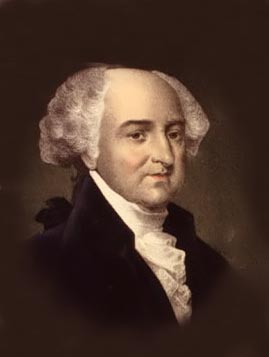
John Addams
Robert Treat Paine “Adams and Liberty”
New York: G. Gilbert, ca. 1798. Music Division, Library of Congress
ADAMS AND LIBERTY

Should the Tempests of War overshadow our land, 

Its bolts could not rend Freedom's temple asunder; 

For, unmoved, at the portal, would George Washington stand, 

And repulse, with his Breast, the assaults of the thunder! 


His sword, from the sleep Of its scabbard would leap, 

And conduct, with its point, ev'ry flash to the deep! 

And ne'er shall the sons of Columbia be slaves, 

While the earth bears a plant and the sea rolls a wave.


Let Fame to the world sound America's voice; 

No intrigue can her sons from the government sever; 

For her pride is John Adams; his laws are her choice, 

And shall flourish, till Liberty slumbers for ever. 


Then unite heart in hand, Like Leonidas's band, 
And swear to the God of ocean and land; 
That ne'er shall the sons of Columbia be slaves, 
While the earth bears a plant and the sea rolls a wave.


"Adam's Fall: The Trip to Cambridge" 1775
("Trip to Cambridge")

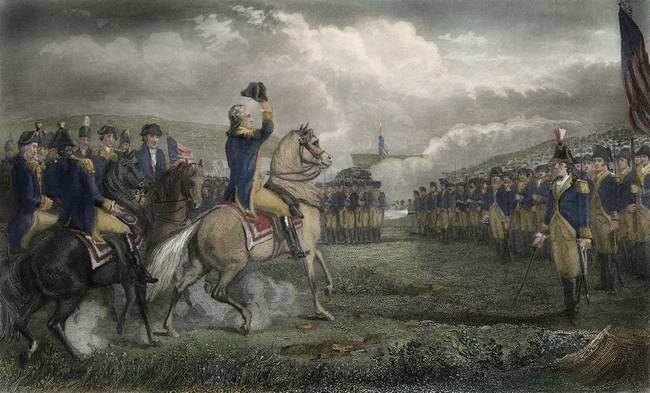
Washington at Cambridge 1775 etching by J. Rogers


TRIP TO CAMBRIDGE

When Congress sent great Washington All clothed in power and breeches,

To meet old Britain's warlike sons And make some rebel speeches; 

'Twas then he took his gloomy way Astride his dapple donkeys, 

And travelled well, both night and day, Until he reach'd the Yankees 


Away from camp, 'bout three miles off, From Lily he dismounted, 

His sergeant brush'd his sun-burnt wig While he the specie counted. 

All prinked up in full bag-wig; The shaking notwithstanding, 

In leathers tight, oh! glorious sight! He reach'd the Yankee landing. 


The women ran, the d----ys too; And all the bells, they tollèd; 
For Britain's sons, by Doodle doo, We're sure to be - consolèd. 
Old mother Hancock with a pan All crowded full of butter, 
Unto the lovely Georgius ran, And added to the splutter. 

Says she, "Our brindle has just calved, And John is wondrous happy. 
He sent this present to you, dear, As you're the 'country's papa' " -
"You'll butter bread and bread butter, But do not butt your speeches.
"You'll butter bread and bread butter, But do not grease your breeches." 

Full many a child went into camp, All dressed in homespun kersey, 
To see the greatest rebel scamp That ever cross'd o'er Jersey. 
The rebel clowns, oh! what a sight! Too awkward was their figure. 
'Twas yonder stood a pious wight, And here and there a n---er. 

Upon a stump, he placed (himself,) Great Washington did he, 
And through the nose of lawyer Close Proclaimed great Liberty. 
The patriot brave, the patriot fair, From fervor had grown thinner, 
So off they march'd, with patriot zeal, And took a patriot dinner.


"Address to the Ladies" 1761
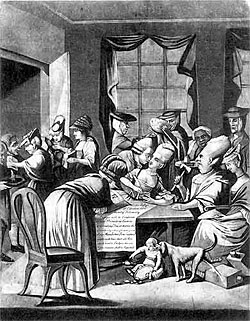
In this cartoon from 1775, these ladies of Edenton, NC, 
sign a declaration supporting the non-importation of 
British goods, specifically tea.
http://shaysrebellion.stcc.edu/shaysapp/music.do?

shortName=address

ADDRESS TO THE LADIES

Young ladies in town, 

And those that live round,

Let a friend at this season advise you:

Since money's so scarce, 

And times growing worse

Strange things may soon hap and surprize you:


First then, Throw aside 

Your high top knots of pride

Wear none but your own country linnen;

Of O economy boast, 
Let your pride be the most

What, if homespun they say 
Is not quite so gay
As brocades, yet be not in a passion,
For when once it is known 
This is much wore in town, 
One and all will cry out, 'tis the fashion! 

And as one, all agree 
That you'll not married be 
To such as will wear London Fact'ry: 
But at first sight refuse, 
Tell'em such you do chuse 
As encourage our own Manufact'ry.

No more Ribbons wear, 
Nor in rich dress appear, 
Love your country much better than fine things, 
Begin without passion, 
'Twill soon be the fashion 
To grace your smooth locks with a twine string.

Throw aside your Bohea, 
And your Green Hyson Tea, 
And all things with a new fashion duty; 
Procure a good store 
Of the choice Labradore, 
For there'll soon be enough here to suit ye;

These do without fear 
And to all you'll appear 
Fair, charming, true, lovely, and cleaver; 
Tho' the times remain darkish, 
Young men may be sparkish. 
And love you much stronger than ever. !O!


AFFAIR OF HONOR

It was on Mr. Peroy's land, At squire Rugeley's corner,

Great H. and G. met sword in hand, upon a point of honor.

G. went before with Colonel E., Together in a carriage;

On horseback followed H. and P., As if to steal a marriage.

On chosen ground they now alight, For battle duly harness'd,

A shady place and out of sight, It show'd they were in earnest.


They met, and in the usual way With hat in hand saluted,

Which was, no doubt, to show how they Like gentlemen disputed.
And then they both together made This honest declaration,
That they came there, by honor led, But not by inclination.
That if they fought 'twas not because Of rancor, spite or passion, 
But only to obey the laws Of custom and the fashion. 

The pistols then, before their eyes, Were fairly prim'd and loaded! 
R. wished, and so did G. likewise, The custom was exploded! 
But as they now had gone so far In such a bloody business, 
For action straight they both prepare With - mutual forgiveness. 
But lest their courage should exceed The bounds of moderation, 
Between the seconds 'twas agreed To fix them each a station. 
The distance stepp'd by Colonel P. Was only eight short paces; 

"Now, gentlemen," says Colonel E., "Be sure to keep your places." 
Quoth H. to G - " Sir, please to fire!" Quoth G. - "No, pray begin, sir;" 
And truly one must needs admire The temper they were in, sir. 
"We'll fire both at once," said he, And so they both presented; 
No answer was returned by G., But silence, sir, consented. 
They paus'd awhile, these gallant foes, By turns politely grinning, 
Till after many cons and pros, H. made a brisk beginning. 

He missed his mark, but not his aim, The shot was well directed; 
It sav'd them both from hurt and shame, What more could be expected? 
Then G. to show he meant no harm, But hated jars and jangles, 
His pistol fired across his arm, From H. almost at angles. 
H. now was called upon by G., To fire another shot, sir; 
He smiled, and "After this," quoth he, "No, truly, I cannot, sir." 

Such honor did they both display, They highly were commended; 
And thus in short, this gallant fray Without mischance was ended. 
No fresh dispute, we may suppose, Will e'er by them be started, 
For now the chiefs, no longer foes, Shook hands, and so they parted.


"Alphabet for Little Masters and Misses" 1775

("Alphabet")


ALPHABET

A, stands for Americans, who scorn to be slaves;

B, for Boston, where fortitude their freedom saves;

C, stands for Congress, which, though loyal, will be free;

D, stands for defence, 'gainst force and tyranny.


Stand firmly, A and Z,

We swear for ever to be free!


E, stands for evils, which a civil war must bring;

F, stands for fate, dreadful to both people and king;

G, stands for George, may God give him wisdom and grace; 
H, stands for hypocrite, who wears a double face. 
J, stands for justice, which traitors in power defy, 
K, stands for king, who should to such the axe apply; 
L, stands for London, to its country ever true, 
M, stands for Mansfield, who hath another view. 
N, stands for North, who to the House the mandate brings, 
O, stands for oaths, binding on subjects not on kings: 
P, stands for people, who their freedom should defend, 
Q, stands for quere, when will England's troubles end ? 
R, stands for rebels, not at Boston but at home, 
S, stands for Stuart, sent by Whigs abroad to roam, 
T, stands for Tories, who may try to bring them back, 
V, stands for villains, who have well deserved the rack. 
W, stands for Wilkes, who us from warrants saved, 
Y, for York, the New, half corrupted, half enslaved, 
Z, stands for Zero, but means the Tory minions, 
Who threatens us with fire and sword, to bias our opinions, 

Stand firmly A and Z, 
We swear, for ever to be free!

"America"
("God Save the King")


"American Hearts of Oak"
by J. W. Hewlings

AMERICAN HEARTS OF OAK
Come rouse up my lads, and join this great cause,
In defence of your liberty, your property, and laws!
'Tis to honor we call you, stand up for your right,
And ne'er let our foes say, we are put to the flight.


For so just is our cause, and so valiant our men,
We always are ready, steady boys, steady;
We'll fight for our freedom again and again.


The Scotch politicians have laid a deep scheme,
By invading America to bring Charlie in; 

And if the Scotch mist's not removed from the throne,
The crown's not worth wearing, the kingdom's undone.


The placemen, and commoners, have taken a bribe,
To betray their own country, and the empire beside; 

And though the colonies stand condemned by some,
There are no rebels here, but are traitors at home.


The arbitrary minister, he acts as he please,
He wounds our constitution, breaks through our laws; 

His troops they are landed, his ships they are moor'd, 
But boys all stand together, they will fall by the sword.

The great Magna Charta is wounded severe;
By accounts from the doctors, 'tis almost past cure. 

Let's defend it with the sword, or die with the braves, 
For we had better die in freedom, than live and be slaves.

They tax us contrary to reason and right,
Expecting that we are not able to fight; 

But to draw their troop home, I do think would be best, 
For Providence always defends the oppress'd.

The valiant Bostonians enter'd the field,
And declare they will fall there before they will yield; 

A noble example! In them we'll confide, 
We'll march to their town, stand or fall by their side.

An union through the colonies will ever remain,
And ministerial taxation will be but in vain, 

For we are all resolved to die or be free;
So they may repeal the acts, for repeal'd they must be.


"The American Hero" 1776 or 1777
by Andrew Law


THE AMERICAN HERO

1. Why should vain mortals tremble at the sight

Of death and destruction in the field of battle,

Where blood and carnage clothe the ground in crimson,

Sounding with death groans?


2. Death will invade us by the means appointed,

And we must all bow to the king of terrors;

Nor am I anxious, if I am prepared,

What shape he comes in.


14. Fame and dear freedom lure me on to battle,
While a fell despot, grimmer than a death's head,
Stings me with serpents, fiercer than Medusa,
To the encounter. 

15. Life, for my country and the cause of freedom, 
Is but a trifle for a worm to part with; 
And if preserved in so great a contest, 
Life is redoubled.

"American Rule Britannia" 1774
(Parody on "Rule Britannia")

AMERICAN RULE BRITANNIA

When Britons first, by Heaven's command, 

Arose from out the azure main, 

This was the charter of the land, 

And guardian angels sung this strain:· 

"Rule Britannia, Britannia rule the waves, 


"Britons never will be slaves." 

To spread bright freedom's gentle sway 

Your isle too narrow for its bound, 

We trac'd wild ocean's trackless way, 

And here a safe asylum found. 
Rule Britannia, Britannia rule the waves, 

But know thy sons will ne'er be slaves. 
While we were simple, you grew great; 
Now swell'd with luxury and pride, 
You pierce our peaceful free retreat 
And haste t'enslave with giant stride. 
Rule Britannia, Britannia rule the waves, 

But free-born sons will ne'er be slaves. 
"Thee haughty tyrants ne'er could tame; 
"All their attempts to pull thee down, 
"Did but arouse thy grievous flame, 
"And work their woe and thy renown." 
Rule Britannia, Britannia rule the waves, 

But know thy sons will ne'er be slaves. 
Let us, your sons, by freedom warm'd, 
Your own example keep in view­ 
'Gainst tyranny be ever arm'd, 
Tho' we our tyrants find-in you. 
Rule Britannia, Britannia rule the waves 

Thy free-born sons will ne'er be slaves. 
With justice and with wisdom reign, 
We then with thee will firJIlly join, 
To make thee mistress of the main, 
And every shore it circles, thine. 
Rule Britannia, Britannia rule the waves, 

Thy children never will be slaves. 
When life glides slowly through thy veins, 
We'll then our filial fondness prove, 
Bound only by the welcome chains 
Of duty, gratitude and love. 
Rule Britannia, Britannia rule the waves, 

Depend on children-not on slaves. 
Our youth shall prop thy tott'ring age; 
Our vigor nerve thy feeble arm; 
In vain thy foes shall spend their rage­ 
We'll shield thee safe from every harm. 
Rule Britannia, Britannia rule the waves, 

Confide in children-not in slaves. 
For thee we'll toil with cheerful heart; 
We'll labor-but we will be free, 
Our growth and strength to thee impart, 
And all our treasures bring to thee. 
Rule Britannia, Britannia rule the waves, 
Thou nor thy sons shall e'er be slaves.


“The Americans’ Challenges”


THE AMERICANS’ CHALLENGES 

Americans To arms Prepare

Honor and Glory Beats For war

Exert Yourselves with Force and might 

Show how The Americans Boys Can fight 

For To maintain Their Charter rights 

Hozah Brave Boys — 


Hark how The warlike Trumpets Sounds 

Where there is nothing but Blood and Wound 

Drums A Beating, Colours Flying, 

Cannons Roaring, Tories Dying 
These are The Noble Effects of war, 
Hozah Brave Boys 

You That Rain masters on The Seas 
Shake of your Youthful Sloth and Ease 
We will make The haughty Tories know, 
The Sorrows They must undergo 
When they Engage Their mortal Foe, 
Hozah Brave Boys 

Display your Colors, mount your Guns, 
Bator Their Castels, Fire their Towns 
You Nighted sons of Americans Fame 
Let not your unDaunted Courage Tame 
We will Drive The Tories Back again; 
Hozah Brave Boys 

Why Should we be Daunted at all, 
Sence we are engaged in so Just a Cause 
In Fighting For our Rights and Laws, 
And dying in so Just a Cause Bemoved 
We Will Prove Their Fatal Overthrow 
Hozah Brave Boys


"American's to Arms" 1775

("Britons to Arms")
http://imagesonline.bl.uk/index.php?service=
search&action=do_quick_search&language=
en&q=%2315274

AMERICAN'S TO ARMS

America’s Sons, yourselves prepare

For liberty now calls for War. 

Exert yourselves with Force and Might, 

Show how Americans can fight, 

And only to maintain their Right - Farewell England. 


Rouse, rouse, my Boys, ’tis Freedom that calls; 

Mount, mount your Guns, prepare your Ball; 

We’ll fight, we’ll conquer, or we’ll die, 

But we’ll maintain our Liberty, 

And hand it to Posterity - Farewell England. 


Hark! from afar, how the Trumpet sounds, 

See the bold Heroes in Blood and Wounds; 

Drums a-beating, Colors flying, 

Cannons roaring, brave Men dying, 
Such are the bold Americans - Farewell England. 

America which rules over the Land, 
Her valiant Sons join Hand in Hand; 
United Sons of Freedom may 
Drive all those Dogs of War away, 
With Triumph crown America - Farewell England. 

Why then should we be daunted at all, 
Since we’ve engag’d in so noble a Call? 
As fighting for our Church and Laws, 
And dying in so just a Cause, 
’Twill prove the fatal Overthrow - Of Old England. 

Quisquis Reipublica sit infelix, felix esse non potest. 
The Cause we fight for animates us high, 
Namely Religion and dear Liberty.


"The American Times"
by Jonathan Odell 1780
Jonathan Odell


THE AMERICAN TIMES

When Faction, pois'nous as the scorpion's sting,

Infects the people and insults the King; 

When foul Sedition skulks no more concealed, 

But grasps the sword and rushes to the field; 

When Justice, Law, and Truth are in disgrace, 

And Treason, Fraud, and Murder fill their place; 

Smarting beneath accumulated woes, 

Shall we not dare the tyrants to expose?


Bad are the Times, almost too bad to paint;

The whole head sickens, the whole heart is faint;

The State is rotten, rotten to the core,

'Tis all one bruize, one putrefying sore.

Hear thy indictment, Washington, at large;
Attend and listen to the solemn charge;
Thou hast supported an atrocious cause
Against thy King, thy Country, and the laws;
Committed perjury, encourag'd lies,
Forced conscience, broken the most sacred ties;
Myriads of wives and fathers at thy hand
Their slaughter'd husbands, slaughter'd sons demand;
That pastures hear no more the lowing kine,--
That towns are desolate, all -- all is thine.

I swear by Him, who rules the earth and sky,
The dread event shall equally apply;
That Clinton's warfare is the war of God,
And Washington shall feel the vengeful rod.

O! may that hour be soon! for pity's sake,
Genius of Britain, from thy slumber wake,
Too long has mercy spoke, but spoke in vain;
Let justice now in awful terror reign


"The American Vicar of Bray" 1779


THE AMERICAN VICAR OF BRAY

When royal George ruled o'er this land and loyalty no harm meant

For Church and King I made a stand and so I got preferment 

I still opposed all party tricks for reasons I thought clear ones 

And swore it was their politics to made us all Presbyterians 


And this is the law that I'll maintain until my dying day, sir 

That whatsoever King might reign, I'll still be Vicar of Bray, sir 

When Stamp Act passed the Parliament to bring some grist to mill, sir 
To back it was my firm intent, but soon there came repeal, sir 

I quickly joined the common cry that we should all be slaves, sir 
The House of Commons was a sty, the Kings and Lords were knaves, sir 
Now all went smooth, as smooth as can be, I strutted and looked big, sir
And when they laid a tax on tea, I was believed a Whig, sir 

I laughed at all the vain pretense of taxing at a distance 
And swore before I'd pay a pence, I'd make a firm resistance 
A Congress now was swiftly called that we might work together 
I thought that Britain would, appalled, be glad to make fair weather

And soon repeal the obnoxious bill, as she had done before, sir 
That we could gather wealth at will and so be taxed no more, sir 
But Britain was not quickly seared, she told another story 
When independence was declared, I figured as a Tory 

Declared it was a rebellion base, to take up arms - I cursed it 
For faith, it seemed a settled case, that we should soon be worsted 
The French alliance now came forth, the Papists flocked in shoals, sir 
Friseurs, marquis, valets of birth and priests to save our souls, sir 

Our "good ally" with towering wing embraced the flattering hope sir 
That we should own him for our King and then invite the Pope, sir 
Then Howe with drum and great parade marched through this famous town, sir
I cried, "May fame his temples shade with laurels for a crown," sir 

With zeal I swore to make amends to good old constitution
And drank confusion to the friends of ou 
But poor Burgoyne's announced my fate the Whigs began to glory 
I now bewailed my wretched state, that e'er I was a Tory 

By night the British left the shore, nor cared for friends a fig, sir 
I turned the cat in pan once more and so became a Whig, sir 
I called the army butchering dogs, a bloody tyrant King, sir 
The Commons, Lords a set of rogues that all deserved to swing, sir 

Since fate has made us great and free and Providence can't alter 
So Congress e'er my King shall be, until the times do alter

An Appeal 1780
("A Song")

A SONG

The old English cause knocks at every man's door, And bids-him stand up for religion and right;

It addresses the rich as well as the poor; And fair liberty, bids them, like Englishmen fight.

And suffer no wrong, From a rebel throng, Who, if they're not quelled, will enslave us ere long; 

Most bravely then let us our liberty prize, Nor suffer the Congress to blind all our eyes; 

Or each rebel cut-purse, will soon give us law, For they are as bad as a Tyler or Straw. 


From France, D'Estaing to America has come. The French banditti will rob our estates;

These robbers -are all protected by Rome; Consult but their annals, record but their dates, 

It's their politics To burn heretics, Or poison by water that's fetch'd from the Styx. 

Let Frenchified rebels, in vain then attempt To bring our own church, or our king to contempt; 

For no rebel cut-purse shall e'er give us law, Should they prove as daring as Tyler or Straw. 


The farces of Rome, with carrying her hosts, Are laugh'd at and jeer'd by the learnèd and wise,
And all her thin tinsels apparently lost, Her stories of relies, and sanctifled lies.
Each ignorant joke Believe, or you smoke, And if we are conquer'd we receive the Pope's yoke; 
But despising the counsels of Adams and Lee, As loyal Americans, we'll die or be free. 
For no rebel cut-throat shall e'er give us law, Should they prove as daring as Tyler or Straw. 


Let curses most vile, and anathemas roar, Let half-ruin'd France, to the Pope tribute pay;
Britain's thundering cannon, shall guard safe our shore; Great George shall defend us, none else we'll obey. 
Then France, join'd by Spain, May labor in vain, For soon the Havana shall be ours again. 
The French then will scamper and quit every state, And find themselves bubbled, when morbleu it's too late. 
For no Frenchman, or rebel imp of the law, In our old constitution can point out a flaw.


"Arnold" 1780
("To the Traitor Arnold")

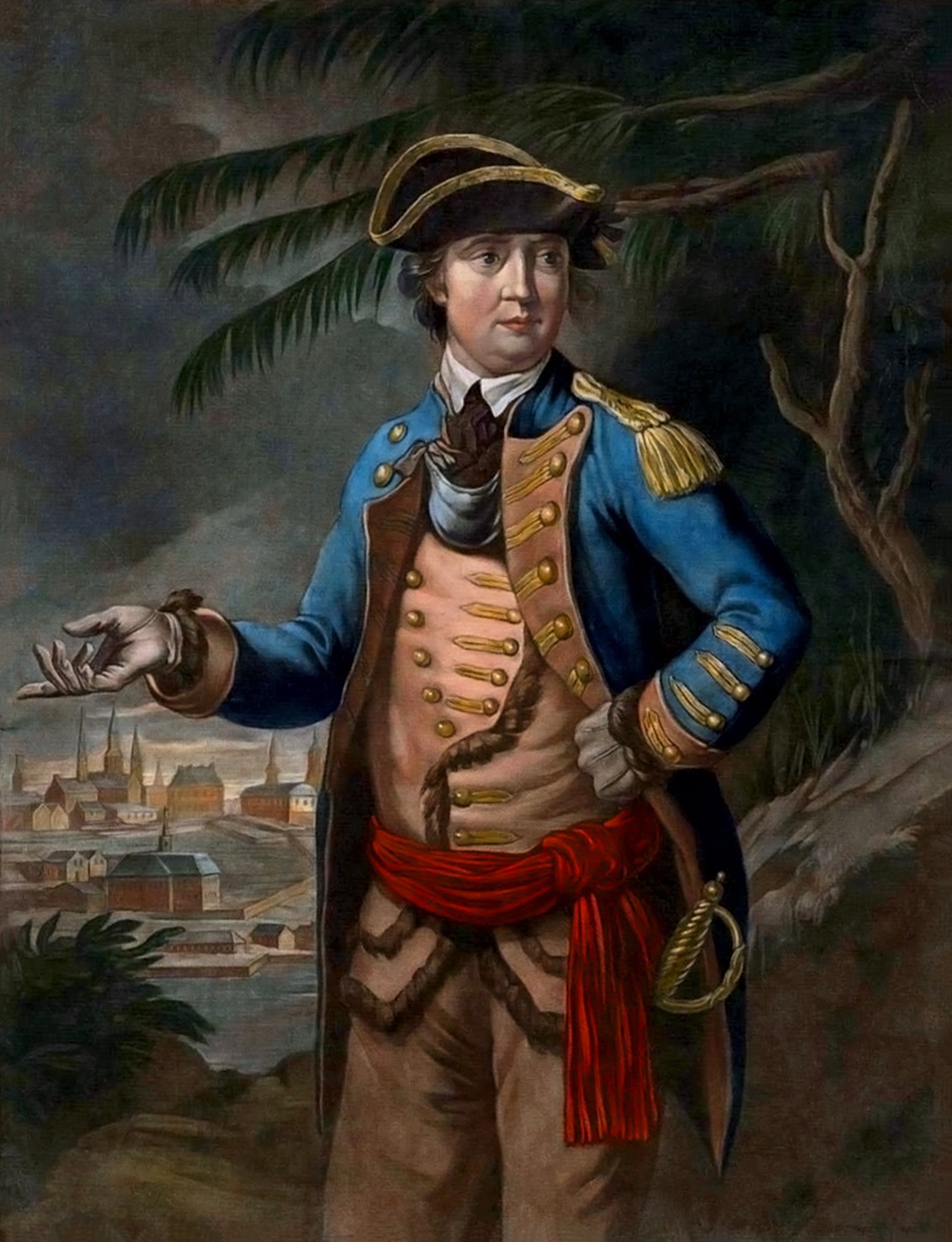
TO THE TRAITOR ARNOLD
Arnold! thy name, as heretofore,
Shall now be Benedict no more;

Since, instigated by the devil,
Thy ways are turn'd from good to evil.

'Tis fit we brand thee with a name,
To suit thy infamy and shame;

And since of treason thou'rt convicted,
Thy name should now be maledicted.

Unless by way of contradiction,
We style thee Britain's Benediction;

Such blessings she, with liberal hand,
Confers on this devoted land.

For instance, only let us mention,
Some proofs of her benign intention;

The slaves she sends us o'er the deep,
The bribes to cut our throats in sleep.


To take our lives and scalps away, The savage Indians keeps in pay,
And Tories worse, by half, than they.
Then in this class of Britain's heroes,
The Tories, savage Indians, Negroes,


Recorded, Arnold's name shall stand,
While Freedom's blessings crown our land.

And odious for the blackest crimes,
Arnold shall stink to latest times.


"A Ballad 1776"
("Smile Britannia")

A BALLAD
Rise, rise, bright genius rise,
Conduct thy sons to war;
Thy spear pois'd to the skies,
Whirl, whirl, thy rapid car;
Fire each firm breast with noble zeal,
To conquer for the common weal.

For years the iron rod,
Has hover'd o'er our heads,
Submit to George's nod,
Whose power all Europe dreads;
The slavish minion trembling cries,
But freedom's sons all fears despise.

All means for peace we've tried,
But found those measures vain,
North's ministerial pride,
Thought fear made us complain
But in the end convinc'd he'll see,
We dread not death, but slavery.

Tho' fatal lust of power,
Has steel'd the tyrant's soul,
Tho' in an ill-timed hour,
He bid his thunders roll,
Great Liberty, inspir'd by thee,
We fly to death or victory !

Great nature's law inspires,
All free-born souls unite,
While common interest fires
Us to defend our rights,
Against corruption's boundless claim,
And firmly fix great freedom's reign.

They foreign troops employ,
For mercenary hire;
Their weakness we enjoy,
Each pulse new ardors fire;
Convinc'd the wretch who fights for pay,
Will never bear the palm away.

They boast their power by sea,
The ruin of our trade,
Our navy soon they'll see,
Wide o'er the ocean spread;
Britain not long shall boast her reign,
O'er the wide empire of the main.

Throughout the universe,
Our commerce we'll extend,
Each power on the reverse,
Shall seek to be our friends,
Whilst our sons, crown'd with wealth immense,
Sing Washington and Common Sense.


"The Ballad of Major Andre"

Asher Brown Durand: The Capture of Major Andre


THE BALLAD OF MAJOR ANDRE

Come, all you brave Americans, And unto me give ear,

I'll sing you now a ditty That will your spirits cheer,

Concerning a young gentleman Who came from Tarrytown, 

Where he met a British officer, A man of high renown. 


Then up spoke this young hero, Young Paulding was his name;

'0 tell us where you're going, sir, And also whence you came.'
'I bear the British flag, sir,' Up answered bold André,
'I have a pass that takes me through, I have no time to stay.'

Then others came around him, And bade him to dismount:
'Come tell us where you're going, Give us a strict account;'
Young Paulding said, 'We are resolved That you shall ne'er pass by';
And so the evidence did prove The prisoner a spy.

He begged for his liberty, He pled for his discharge,
And oftentimes he told them, If they'd set him at large,
'Of all the gold and silver I have laid up in store,
But when I reach the city I will send you ten times more.'

'We scorn this gold and silver You have laid up in store,'
Van Vert and Paulding both did cry, 'You need not send us more.'
He saw that his conspiracy Would soon be brought to light, 
He begged for pen and paper And he asked for to write.

The story came to Arnold Commanding at the Fort:
He called for the Vulture And sailed for New York;
Now Arnold to New York has gone, A-fighting for his King,
And left poor Major André On the gallows for to swing.

André was executed, He looked both meek and mild,
His face was fair and handsome, And pleasantly he smiled.
It moved each eye with pity, And every heart there bled,
And everyone wished him released And Arnold in his stead.

He was a man of honor! In Britain he was born,
To die upon the gallows Most highly he did scorn.
And now his life has reached its end So young and blooming still-
In Tappan's quiet countryside He sleeps upon the hill.

"Ballad of the Tea Party"
Boston Tea Party 1773 (Engraving:1789)


BALLAD OF THE TEA PARTY

Tea ships near to Boston lying on the wharf a numerous crew 

Sons of freedom, never dying then appeared in view 


With a rink tum, dink tum, fa la link tum

Then appeared in view

With a rink tum, dink tum, fa la link tum 

Then appeared in view 

Armed with hammers, axes, chisels, weapons new for warlike deed 
Toward the tax-ed, freighted vessels, on they came with speed 

With a rink tum, dink tum, fa la link tum 
Then appeared in view 
With a rink tum, dink tum, fa la link tum 
Then appeared in view 

Overboard she goes, my boys, heave ho where darkling waters roar 
We love our cup of tea full well, but love our freedom more 

With a rink tum, dink tum, fa la link tum 
Then appeared in view 
With a rink tum, dink tum, fa la link tum 
Then appeared in view 

Deep, into the sea descended cursed weed of China's coast 
Thus at once our fears were ended, rights shall ne'er be lost

"Banks of the Dee" 1775
http://www.flickr.com/photos/pixellie/3483279316/


BANKS OF THE DEE 

'Twas summer, and softly the breezes were blowing, 

And sweetly the nightingale sang from the tree.

At the foot of a hill, where the river was flowing,

I sat myself down on the banks of the Dee. 


Flow on, lovely Dee, flow on thou sweet river,

Thy banks, purest stream, shall be dear to me ever, 

For there I first gain'd the affection and favor 
Of Jamie, the glory and pride of the Dee. 

But now he's gone from me, and left me thus mourning, 
To quell the proud rebels, for valiant is he; 
But ah! there's no hope of his speedy returning, 
To wander again on the banks of the Dee: 

He's gone, hapless youth, o'er the rude roaring billows, 
The kindest, the sweetest, of all his brave fellows; 
And left me to stray 'mongst these once lovèd willows, 
The loneliest lass on the banks of the Dee. 

But time and my prayers may perhaps yet restore him, 
Blest peace may restore my dear lover to me, 
And when he returns, with such care I'll watch o'er him, 
He never shall leave the sweet banks of the Dee. 

The Dee then will flow, all its beauty displaying, 
The lambs on its banks will again be seen playing, 
Whilst I, with my Jamie, am carelessly straying, 
And tasting again all the sweets of the Dee.


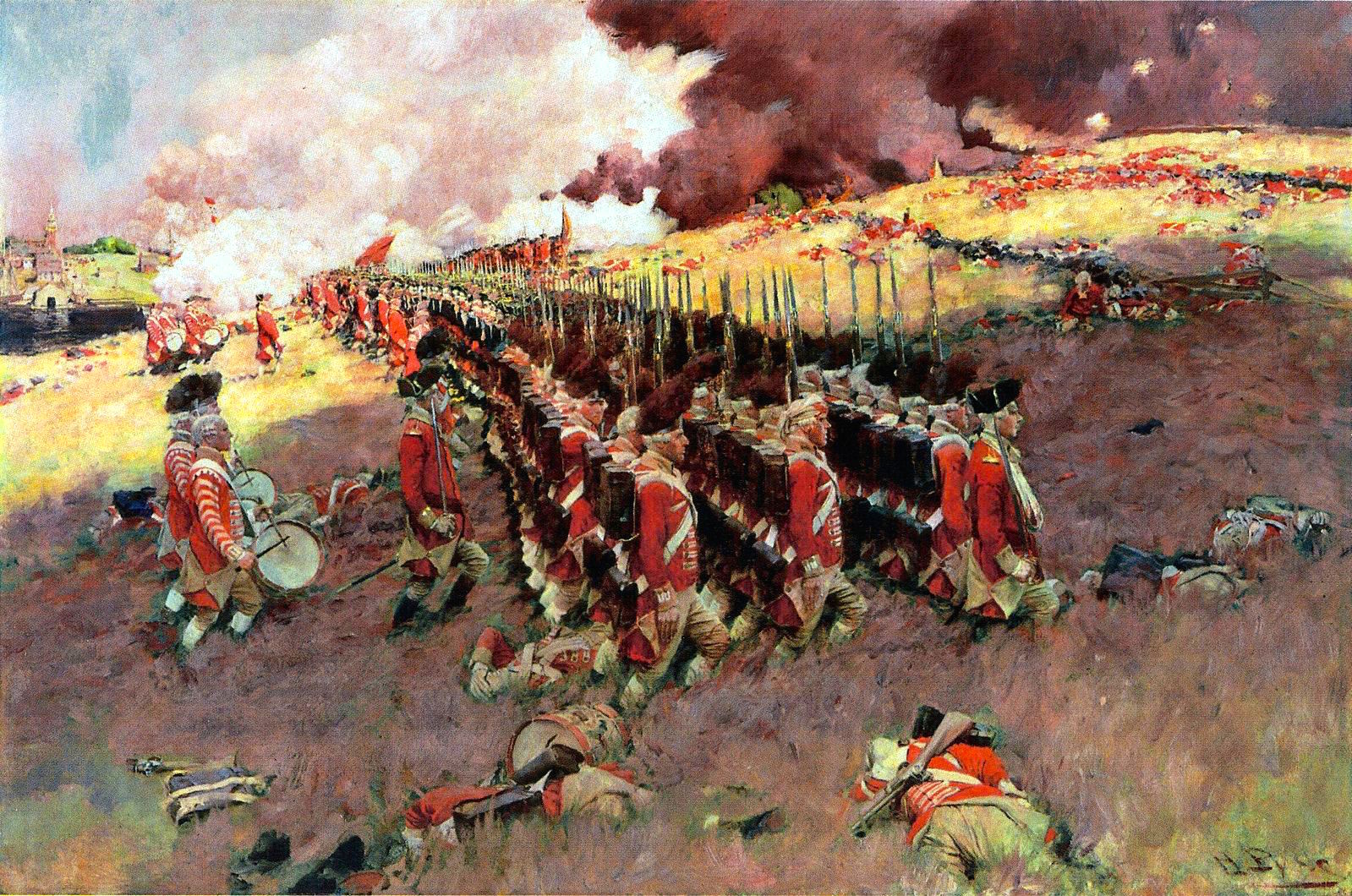
"Battle of Bunker Hill"
The Battle of Bunker Hill, by Howard Pyle, 1897

BATTLE OF BUNKER HILL

It was on the seventeenth, by break of day, The Yankees did surprise us, 

With their strong works they had thrown up, To burn the town and drive us. 

But soon we had an order came, An order to defeat them; 

Like rebels stout, they stood it out, And thought we ne’er could beat them. 


About the hour of twelve that day, An order came for marching, 

With three good flints and sixty rounds, Each man hop’d to discharge them. 

We march’d down to the Long Wharf, Where boats were ready waiting; 

With expedition we embark’d, Our ships kept cannonading. 


And when our boats all filled were, With officers and soldiers, 

With as good troops as England had, To oppose, who dare control us. 
And when our boats all filled were, We row’d in line of battle, 
Where showers of ball like hail did fly, Our cannon loud did rattle. 


There was Copp’s hill battery near Charlestown, Our twenty-fours they played; 
And the three frigates in the stream, That very well behaved.
The Glasgow frigate clear’d the shore, All at the time of landing, 
With her grape shot and cannon balls, No Yankees e’er could stand them.


And when we landed on the shore, We draw’d up all together; 
The Yankees they all man’d their works, And thought we’d ne’er come thither.
But soon they did perceive brave Howe, Brave Howe, our bold commander; 
With grenadiers, and infantry, We made them to surrender. 


Brave William Howe, on our right wing,Cry’d boys fight on like thunder; 
You soon will see the rebels flee, With great amaze and wonder. 
Now some lay bleeding on the ground, And some fell fast a running; 
O’er hills and dales, and mountains high, Crying, zounds! brave Howe’s a coming.

Brave Howe is so considerate, As to guard against all dangers; 

He allow’d each half a gill this day, To rum we are no strangers. 

They began to play on our left wing, Where Pigot, he commanded; 

But we return’d it back again, With courage most undaunted. 


To our grape shot and musket balls, To which they were but strangers, 

They thought to come with sword in hand, But soon they found their danger. 

And when the works were got into, And put them to the flight, sir, 

They pepper’d us, poor British elves, And show’d us they could fight, sir.


And when their works we got into, With some hard knocks and danger; 

Their works we found both firm and strong, Too strong for British Rangers.

But as for our Artillery, They gave all way and run, 

For while their ammunition held, They gave us Yankee fun. 


But our commander, he got broke, For his misconduct, sure, sir; 
The shot he sent for twelve pound guns, Were made for twenty-fours, sir. 
There’s some in Boston, pleas’d to say, As we the field were taking, 
We went to kill their countrymen, While they their hay were making. 

For such stout whigs I never saw, To hang them all I’d rather; 
By making hay with musket balls, Lord Howe cursedly did bother. 
Bad luck to him by land and sea, For he’s despis’d by many; 
The name of Bunker Hill he dreads, Where he was flogg’d most plainly. 


And now my song is at an end, And to conclude my ditty; 

’Tis only Britons ignorant, That I most sincerely pity. 

As for our King and William Howe, And General Gage, if they’re taken, 

The Yankees will hang their heads up high, On that fine hill call’d Beacon.

"Battle of the Kegs" 1778
words by Francis Hopkinson
("Maggie Lawder" or "Yankee Doodle")
The Submarine Turtle


BATTLE OF THE KEGS

Gallants attend, and hear a friend, Trill forth harmonious ditty;

Strange things I'll tell, Which late befell, In Philadelphia City.


'Twas early day, as poets say, Just when the sun was rising,

A soldier stood on a log of wood, And saw a site surprising.

As in a maze, he stood to gaze, The truth can't be denied, sir

He spied a score - of kegs, or more, Come floating down the tide, sir,


A sailor too, in jerkin blue, The strange appearance viewing,

First damned his eyes, in great surprise, Then said, Some mischief's brewing.
These kegs now hold the rebels bold, Pack'd up like pickled herring:
And they're come down to attack the town, In this new way of ferrying.

The soldier flew, the sailor too, And, scared almost to death, sir,
Wore out their shoes, to spread the news, And ran til out of breath, sir.
Now up and down throughout the town, Most frantic scenes were acted:
And some ran here, and some ran there Like men almost distracted,

Some fire cried, which some denied, But said the earth had quaked;
And girls and boys, with hideous noise Ran through the town half-naked.
Sir William he, snug as a flea, Lay all this time a-snoring,
Nor dreamed of harm, as he lay warm, In bed with Mrs. Loring.

Now in a fright he starts upright, Awaked by such a clatter;
He rubs his eyes and boldly cries, For God's sake what's the matter?
At his bedside, he then espied, Sir Erskine in command, sir,
Upon one foot he had one boot, And t'other in his hand, sir.

Arise! Arise! Sir Erskine cries; The rebels - more's the pity -
Without a boat, are all on float, And ranged before the city.
The motley crews, in vessels new, With Satan for their guide, sir,
Packed up in bags or wooden kegs, Come driving down the tide, sir.

Therefore prepare for bloody war; These kegs must all be routed;
Or surely we despised shall be, And British courage doubted.
The royal band now ready stand, All ranged in dread array, sir,
With stomach stout to see it out, And make a bloody day, sir.

The cannons roar, from shore to shore, The small arms make a rattle:
Since wars began I'm sure no man, E'er saw so strange a battle.
The fish below swam to and fro, Attacked form every quarter;
Why sure, thought they, the devil's to pay, 'Mongst folk above the water.

These kegs 'tis said, tho' strongly made, Of rebel staves and hoops, sir,
Could not oppose their powerful foes, The conquering British troops, sir.
From morn to night, these men of might Displayed amazing courage;
And when the sun was fairly down, Retired to sup their porridge:

An hundred men with each a pen, Or more upon my word, sir,
It is most true, should be too few, Their valor to record sir.
Such feats did they perform that day Upon these wicked kegs, sir,
That years to come, if they get home, They'll make their boasts and brags, sir.


“Courtesy of the Penn University Archives and Records”
http://drinkingandtherevolution.wordpress.com/2011/12/
"The Battle of Saratoga"

THE BATTLE OF SARATOGA
Come unto me, ye heroes, And I the truth will tell
Concerning many a soldier Who for his country fell.
Burgoyne, the King's commander And cursed Tory crew,
With Indians and Canadians He up the Champlain flew.

Chorus: He up the Champlain flew,
He up the Champlain flew,
With Indians and Canadians
He up the Champlain flew.

Before the Ticonderoga, Full well both night and day
Their motions we observed Before the bloody fray;
Burgoyne sent Baum to Bennington, With Hessians there he went,
To plunder and to murder Was fully their intent.

Chorus: Was fully their intent,
Was fully their intent,
To plunder and to murder,
Was fully their intent.

But little did they know then With whom they had to deal.
It was not quite so easy Our stores and stocks to steal.
Stark would give them only A portion of his lead,
With half his crew ere sunset, Baum lay among the dead.

Chorus:
The 19th of September, The morning cool and clear,
Gates addressed the army Each soldier's heart to cheer.
Burgoyne, he cried, advances, But we will never fly,
But rather than surrender, We'll fight until we die!

Chorus:
The Seventh of October, They did capitulate,
Burgoyne and his proud army We did our prisoners make.
And vain was their endeavor Our men to terrify
Though death was all around us, Not one of us would fly!

Chorus:
Now here's a health to Herkimer And our commander Gates!
To Freedom and to Washington Whom every Tory hates.
Likewise unto our Congress - God grant it long to reign-
Our country, rights and justice Forever to maintain!


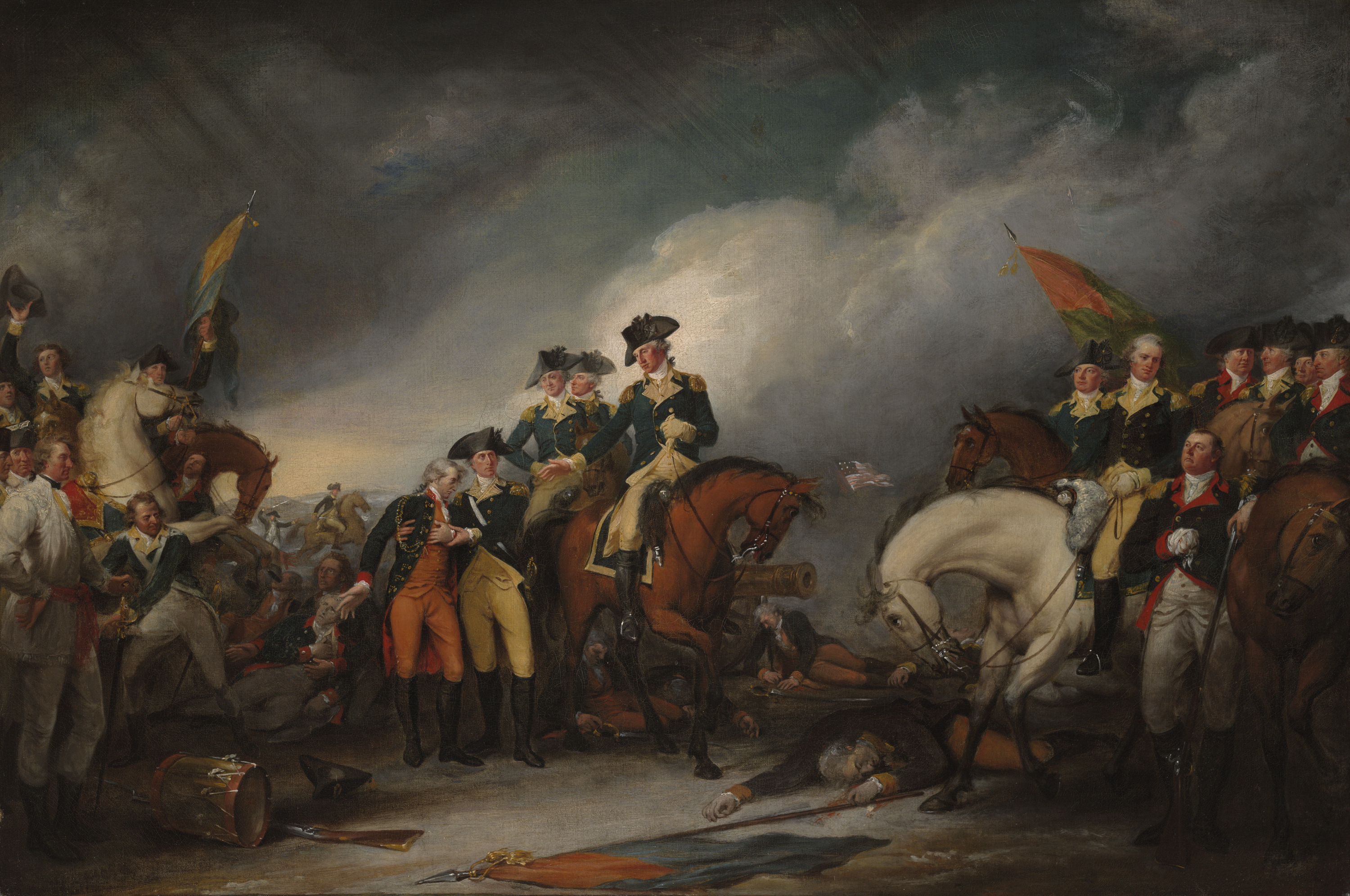
"Battle of Trenton" 1776
("On Christmas Day in '76")
Capture of the Hessians at Trenton, by John Trumbull


BATTLE OF TRENTON

ON Christmas day in seventy-six, 
Our ragged troops with bayonets fix'd,

For Trenton marched away.

The Delaware see ! the boats below! 
The light obscured by hail and snow!

But no signs of dismay.


Our object was the Hessian band, 
That dared invade fair freedom's land,

And quarter in that place.

Great Washington he led us on, 
Whose streaming flag, in storm or sun,

Had never known disgrace.


In silent march we pass'd the night, 
Each soldier panting for the fight,

Though quite benumb'd with frost.

Greene, on the left, at six began, 
The right was led by Sullivan,

Who ne'er a moment lost.

Their pickets storm'd, the alarm was spread, 
That rebels risen from the dead
Were marching into town.
Some scamper'd here, some scamper'd there,
And some for action did prepare;
But soon their arms laid down.

Twelve hundred servile miscreants, 
With all their colors,  guns, and tents,
Were trophies of the day.
The frolic o'er, the bright canteen, 
In centre, front, and rear was seen
Driving fatigue away.

Now, brothers of the patriot bands, 
Let's sing deliverance from the hands
Of arbitrary sway. 
And as our life is but a span, 
Let's touch the tankard while we can,
In memory of that day.

"Black Velvet Band"


In a neat little town they call Belfast 
Apprenticed in trade I was bound 
And many an hour of sweet happiness 
I spent in that neat little town.

[Alternate First Verse: Well, I was out strolling one evening 
Not intending to stay very long 
When I met with a frolicsome damsel 
As She came a trippin along ]

Chorus:  Her eyes they shone like the diamond 
You'd think she was queen of the land 
And her hair hung over her shoulder 
Tied up in a black velvet band

Then bad misfortune befell me 
And caused me to stray from the land 
Far away from my friends and companions 
To follow the black velvet band.

Well a watch, she pulled out her pocket 
And slipped it right into my hand 
On the very first day that I met her, 
Bad luck to the black velvet band

Chorus: 

Before judge and jury next morning 
Both of us did appear 
A gentleman claimed his jewelry 
And the case against us was clear.

Chorus: 

Now seven long years transportation 
Right down to Van Dieman's Land 
Far away from my friends and companions 
To follow the black velvet band

Chorus: 

So come all you jolly young fellows 
I'd have you take warning by me 
And whenever you're out on the liquor 
Beware of the pretty colleen

Chorus: 

They'll fill you with whiskey and porter 
Until You're not able to stand 
And the very next thing that you know 
You're landed in Van Dieman's Land

"The Blasted Herb" 1774
Attributed to Meshech Weare 

("India Tea")


THE BLASTED HERB
Rouse every generous thoughtful mind, The rising danger flee, 
If you would lasting freedom find, Now then abandon tea. 
Scorn to be bound with golden chains, Though they allure the sight; 
Bid them defiance, if they claim Our freedom and birth-right. 

Shall we our freedom give away, And all our comfort place 
In drinking of outlandish tea, Only to please our taste? 
Forbid it Heaven, let us be wise, And seek our country's good, 
Nor ever let a thought arise, That tea should be our food. 

Since we so great a plenty have, Of all that's for our health; 
Shall we that blasted herb receive, Impoverishing our wealth? 
When we survey the breathless corpse, With putrid matter filled; 
For crawling worms, a sweet resort, By us reputed ill. 

Noxious effluvia sending out, From its pernicious store, 
Not only from the foaming mouth, But every lifeless pore. 
To view the same enrolled in tea, Besmeared with such perfumes, 
And then the herb sent o'er the sea, To us it tainted comes 

Some of it tinctured with a filth, Of carcasses embalmed; 
Taste of this herb, then, if thou wilt! Sure me it cannot charm. 
Adieu! away, oh tea! begone! Salute our taste no more; 
Though thou art coveted by some Who're destined to be poor.


"The Bold Volunteer"
("Month of Sweet May" or "The Nightingale")

"Breed's Hill" 1775
("The Burning of Charlestown")


THE BURNING OF CHARLESTOWN

Palmyra's prospect, with her tumbling walls, 
Huge piles of ruin heap'd on every side,

From each beholder, tears of pity calls, 
Sad monuments, extending far and wide.


Yet far more dismal to the patriot's eye, 

The drear remains of Charlestown's former show,

Behind whose walls did hundred warriors die, 
And Britain's centre felt the fatal blow.


To see a town so elegantly form'd, 
Such buildings graced with every curious art,

Spoil'd in a moment, on a sudden storm'd, 
Must fill with indignation every heart.


But when we find the reasons of her fate 

To be but trifling - trifling did I say ?

For being noble ! daring to be great, 
Nor calmly yielding to tyrannic sway!


To see the relics of that once famed place, 
Pointing to Heaven, as 'twere in ardent cry,

By lawless power robb'd of every grace, 
Yet calling bolts of vengeance from on high:


To find, I say, such dealings with mankind, 

To see those royal robbers planted near

Those glorious buildings, turning into wind, 
And loath to mingle with the common air.


And such chastisement coming from a state 
Who calls herself our parent, nurse, and friend
Must rouse each soul that's noble, frank, and great, 
And urge us on our lives and all to spend !

Oh ! spot once graceful; but, alas ! no more; 

Till signs shall end, and time itself shall cease,
Thy name shall live, and on fame's pinions soar, 
To mark grim blackness on Great Britain's face.

Nor shall the blood of heroes on the plain, 
Who nobly fell that day in freedom's cause,
Lie unreveng'd, though with thy thousands slain,  
Whilst there's a King who fears nor minds thy laws.

Shall Cain who madly spilt his brother's blood, 

Receive such curses from the God of all?
Is not that Sovereign still as just and good, 
To hear the cries of children when they call ?

Yes, there's a God whose laws are still the same, 
Whose years are endless, and his power is great;
He is our God: Jehovah is his name; 
With him we trust our sore oppressèd state.

When he shall rise (oh, Britain, dread the day, 

Nor can I stretch the period of thy fate);
What heart of steel, what tyrant then shall sway, 
A throne that's sinking by oppression's weight?

Thy crimes, oh North, shall then like spectres stand, 
Nor Charlestown hindmost in the ghastly roll,
And faithless Gage, who gave the dread command, 
Shall find dire torments gnaw upon his soul.

Yea, in this world, we trust that ills so dread, 

Which fills the nation with such matchless woes,
Shall fall with double vengeance on thy head, 
Nor 'scape those minions which thy court compose.


"The British Grenadiers"


"British Light Infantry on Maneuvers"by Philippe Jacques de Loutherbourg


BRITISH LIGHT INFANTRY 

For battle prepared in their country's just cause, 

Their king to avenge and support all his laws; 

As fierce as a tiger, as swift as the roe, 

The British Light Infantry rush on their foe. 


Though rebels unnumber'd oppose their career, 

Their hearts are undaunted; they're strangers to fear; 

No obstacles hinder; resistless they go, 

Ard death and destruction attend every blow. 


'Cross the deep-gullied vale, up the mountain's steep side, 

Through the rough foaming river's impetuous tide 

O'er the fortified redoubt, close Avedged in array. 

Regardless of safety they follow their prey. 


The alarm of the drum and the cannon's loud roar; 

The musket's quick flash, but inflames them the more. 

No dangers appal, for they fear no control, 

But glory and conquest inspires every soul. 

Whenever their foe stands arrang'd in their sight, 
With ardor impatient they pant for the fight; 
Rout, havoc, confusion they spread through the field. 
And rebellion and treason are forced to yield.


"Bunker Hill"

("The American Hero")

BUNKER HILL
Why should vain Mortals tremble at the sight of

Death and Destruction in the field of battle,

Where Blood and Carnage, where Blood and Carnage,

Clothe the Ground in Crimson, 


Sounding with Death-Groans? 

Death will invade us by the means appointed, 

And we must all bow to the King of Terrors; 

Nor am I anxious, nor am I anxious, 

If I am prepared, what shape he comes in. 

Still shall the Banner of the King of Heaven

Never advance where I'm afraid to follow;

While that precedes me, while that precedes me

With an open Bosom, War, I defy thee.


Life, for my Country and the Cause of Freedom,

Is but a Trifle for a Worm to part with;

And if preserved, and if preserved

In so great a Contest, Life is redoubled.

"Burgoyne's Overthrow" 1777
("Burgoyne's Overthrow at Saratoga")
Burgoyne surrenders to Gates


BURGOYNE'S OVERTHROW AT SARATOGA 

Here followeth the direful fate Of Burgoyne and his army great. 

Who so proudly did display The terrors of despotic sway. 

His power, and pride, and many threats, Have been brought low by fort'nate Gates. 

To bend to the United States. 

British prisoners by Convention, .... Foreigners — by Contra- vention, 


Tories sent across the Lake, Burgoyne and suite, in state, 

Sick and wounded, bruised and pounded, Ne'er so mucli before confounded. 

Prisoners of war before Convention, Deserters come with kind intention, 

They lost at Bennington's great battle. Where glorious Starke's arms did rattle. 


Killed in September and October, . . Ta'en by brave Brown, some drunk, some sober, 

Slain by high-famed Herkerman, On both flanks, on rear and van, 

Indians, suttlers, and drovers. Enough to crowd large plains all over. 

And those whom grim Death did prevent From fighting against our continent; 


And also those who stole away, Lest down their arms they should lay. 

Abhorring that obnoxious day; 

The whole make fourteen thousand men, Wlio may not with us fight again. 
This is a pretty just account Of Burgoyne's legions whole amount, 
Who came across the Northern Lakes To desolate our happy States. 

Their brass cannons we have got all — Fifty-six — both great and small; 
And ten thousand stand of arms, To prevent all future harms; 
Stores and implements complete, Of workmanship exceeding neat; 
Covered wagons in great plenty, And proper harness, no way scanty. 

Among our prisoners there are Six Generals, of fame most rare; 
Six members of their Parliament— Reluctantly they seem content; 
Three British Lords, and Lord Bellcaras, Who came, our country free to harass. 
Two Baronets of high extraction, Were sorely wounded in the action.


"Burrowing Yankee" 1776


BURROWING YANKEES 

Ye Yankees who, mole-like, still throw up the earth. 

And like them, to your follies are blind from your birth; 

Attempt not to hold British troops at defiance, 

True Britons, with whom you pretend an alliance. 


Mistake not; such blood ne'er run in your veins, 

'Tis no more than the dregs, the lees, or the drains; 

Ye affect to talk big of your hourly attacks; 

Come on! and I'll warrant, we'll soon see your backs. 


Such threats of bravados serve only to warm 

The true British hearts, you ne'er can alarm; 

The Lion once rous'd, will strike such a terror, 

Shall show you, poor fools, your presumption and error. 


And the time will soon come when your whole rebel race 

Will be drove from the lands, nor dare show your face: 

Here's a health to great George may he fully determine, 

To root from the earth all such insolent vermin.