"Music is the universal language of mankind."
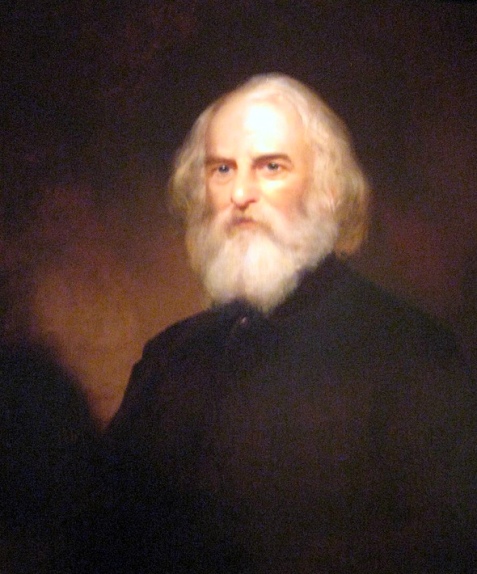
AUTHOR: Henry Wadsworth Longfellow
MEANING OF THE QUOTE:
"No matter what language you speak you can still
communicate to anyone your feelings through music."


This was architectur'd thus
By the great Oceanus!
Here his mighty waters play
Hollow organs all the day;
Here by turns his dolphins all,
Finny palmers great and small,
Come to pay devotion due-
Each a mouth of pearls must strew.


the hero of an epic poem "translated"
COMPOSER
MENDELSSOHN
 |
| http://www.bbc.com/news/uk-scotland-glasgow-west-12008512 |
HEBRIDES OVERTURE

HEBRIDES OVERTURE
"FINGAL'S CAVE"
Claudio Abbado, Conductor
London Symphony Orchestra
 |
| First theme - a deep sombre tune on bassoons, violas and cellos. |
 |
| Second theme on flutes. |
 |
| Third theme, a flowing melody on the cellos. |
HEBRIDES OVERTURE
"FINGAL'S CAVE"
Gary M Schneider, Conductor
Overture, The Hebrides
(Fingal's Cave), Op. 26
Felix Mendelssohn Bartholdy
(1809-1847)
THIS PIECE HAS OTHER
ALTERNATE TITLES:
Die Hebriden
Hebrides Overture
Ossian in Fingal’s Cave
Overture to the Isles of Fingal
Overture to the Lonely Isle
INFORMATION FROM:
October 10, 1993
Program Notes by Thomas G. Rigney
 |
| http://www.otago.ac.nz/library/exhibitions/insearchofscotland/cabinet10-2.html |
Mendelssohn visited the Hebrides,
islands off the west coast of Scotland,
in 1829 as part of a summer vacation.
 |
| Annotated drawing by Mendelssohn from his visit to Scotland in 1829 which inspired his Hebrides Overture and Scottish Symphony. |
One of the attractions there was a huge
cavern on the island of Staffa, Fingal's
cave. Upon his return to Germany he
began writing the (concert) overture
and completed it in 1832.
Concert overtures are not drawn from a stage
work or opera, but rather, are stand-alone works
to be programmed as an overture in a concert
hall. Other composers of famous concert overtures
work or opera, but rather, are stand-alone works
to be programmed as an overture in a concert
hall. Other composers of famous concert overtures
include Berlioz, Tchaikovsky, and Brahms.
It was premiered with the
with Thomas Attwood conducting and
received great reviews from the critics.

Even Richard Wagner,

one of Mendelssohn's biggest
critics, later described the work as
one of Mendelssohn's biggest
critics, later described the work as
"one of the most beautiful
pieces we possess."
pieces we possess."
It should be noted that the purpose of
the work was not to be a tone poem, but
rather as a reaction to an event, as in the
the work was not to be a tone poem, but
rather as a reaction to an event, as in the

This piece is is a one movevent work
written in a usual Sonata-Allegro form.
 |
| http://www.dailykos.com/story/2013/04/19/1203063/-Thursday-Classical- Music-OPUS-111-The-Fingal-s-Cave-Overture-by-Felix-Mendelssohn# |
The overture opens with lower strings
and bassoons playing the main theme,
which is evocative of the waves of the
sea. This theme is repeated in the violins.
A second theme is introduced in the
cellos and clarinets as a variant to the
main theme. Dialogue between the
and bassoons playing the main theme,
which is evocative of the waves of the
sea. This theme is repeated in the violins.
A second theme is introduced in the
cellos and clarinets as a variant to the
main theme. Dialogue between the
strings and winds of the main theme
leads back to the opening texture. The
piece ends with a calm subsiding of the
orchestra to silence, as if the motion of
the sea itself has come to a rest.

LISTENING GUIDE
EXPOSITION
Theme 1
Theme 1
Theme 2
Coda
The poet John Keats
EXPOSITION
Theme 1
A theme representing the waves at the mouth
of the cave. The theme is repeated over and
over to recreate the murmuring of the waves.
Note how the theme is often repeated at a lower
dynamic level to represent the echo from
within the cave.
Theme 2
A theme that is longer and quieter than Theme
1. The theme rises and falls in pitch and dynamics
to represent the waters crashing on rocks and
flowing back to the sea. Some say the theme
portrays the inner tranquility of the cave in
the midst of the turbulent sea.
Codetta
A section used to end the exposition. Note the
change in rhythm that represents the
fierceness of the wind and sea.
DEVELOPMENT
The two themes from the exposition
are developed and expanded. Note how the
themes advance and retreat like water hitting
the cave. Listen for the calmness
preceding the foreboding of a storm that
eventually hits the island with full fury.
RECAPITULATIONTheme 1
Theme 2
Coda
We should feel both the turbulent chaos
and majesty of nature before the music
fades to silence.
 |

visited Staffa, Fingal's Cave,
in 1818 (Mendelssohn went in 1829)
in 1818 (Mendelssohn went in 1829)
and he wrote a poem about it called
'Staffa.' The following is a section of
the poem describing the natural music
'Staffa.' The following is a section of
the poem describing the natural music
FINGAL'S CAVE, ISLE OF STAFFA
Listen to the Natural Music
https://www.youtube.com/watch?v=CgbENxRN3CQ
made by the power of
nature heard in the cave:
https://www.youtube.com/watch?v=CgbENxRN3CQ
made by the power of
nature heard in the cave:
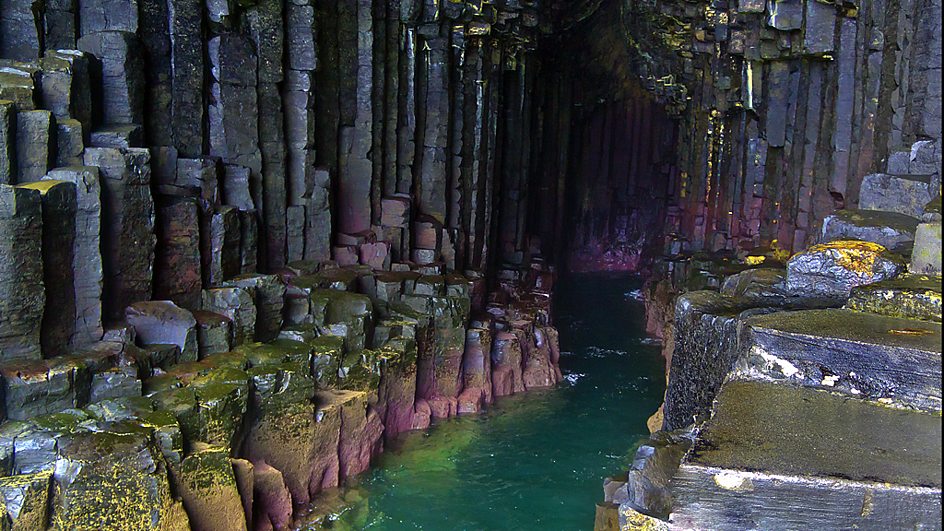
"STAFFA"
John KeatsThis was architectur'd thus
By the great Oceanus!
Here his mighty waters play
Hollow organs all the day;
Here by turns his dolphins all,
Finny palmers great and small,
Come to pay devotion due-
Each a mouth of pearls must strew.
 |
| Thomas Moran: Fingal's Cave, detail, 1884 |
Many a mortal of these days,
Dares to pass our sacred ways,
Dares to touch audaciously
This Cathedral of the Sea!
Dares to pass our sacred ways,
Dares to touch audaciously
This Cathedral of the Sea!
 |
J. M. W. Turner: Staffa, Fingal's Cave, 1832
(Painted the same year that Mendelssohn’s concert overture received its première.) |
I have been the pontiff-priest
Where the waters never rest,
Where a fledgy sea-bird choir
Soars for ever; holy fire
I have hid from mortal man;
Proteus is my Sacristan.
Where the waters never rest,
Where a fledgy sea-bird choir
Soars for ever; holy fire
I have hid from mortal man;
Proteus is my Sacristan.
The following is another poem
about the Staffa Islands by
William Wordsworth:
 |
| William Wordsworth |
William Wordsworth
Ye shadowy Beings, that have rights and claims
In every cell of Fingal’s mystic Grot,
Where are ye? Driven or venturing to the spot,
Our fathers glimpses caught of your thin Frames,
And, by your mien and bearing knew your names;
And they could hear ‘his’ ghostly song who trod
Earth, till the flesh lay on him like a load,
While he struck his desolate harp without hopes or aims.
Vanished ye are, but subject to recall;
Why keep ‘we’ else the instincts whose dread law
Ruled here of yore, till what men felt they saw,
Not by black arts but magic natural!
If eyes be still sworn vassals of belief,
Yon light shapes forth a Bard, that shade a Chief.
In every cell of Fingal’s mystic Grot,
Where are ye? Driven or venturing to the spot,
Our fathers glimpses caught of your thin Frames,
And, by your mien and bearing knew your names;
And they could hear ‘his’ ghostly song who trod
Earth, till the flesh lay on him like a load,
While he struck his desolate harp without hopes or aims.
Vanished ye are, but subject to recall;
Why keep ‘we’ else the instincts whose dread law
Ruled here of yore, till what men felt they saw,
Not by black arts but magic natural!
If eyes be still sworn vassals of belief,
Yon light shapes forth a Bard, that shade a Chief.
 |
| Benjamin West: Sir Joseph Banks, 1773 |
discovered the cave in 1772 while on a natural
history expedition to Iceland. It was
named after Fingal,
 |
| Nicolai Abildgaard: Fingal Sees the Ghosts of His Ancestors in the Moonlight, 1778 |
this translation was challenged immediately)
and published by 18th Century Scots poet-
historian James Macpherson


historian James Macpherson
in 1761 based on a hero
from a third-century
THE INTRODUCTORY ODE:
Imagination, mighty power!
Where dost thou guide my roving mind?
By time, by distance unconfin'd
On Fancy's rapid wings I fly
To Morven's coast, where mountains tower,
And break the clouds that roll on high.
Before my view the dark-brown heath extends,
From reed-crown'd lakes the creeping mists exhale:
Down the rock bursting, the rude stream descends,
And foams along the solitary vale.
Cona, thy waters murmur in my ear!
Selma, thy halls unfold!
There sits FINGAL: — the chiefs of old
Gaze on the ruler of the war…
Mendelssohn's overture
helped to popularize the cave as a tourist
destination and during Victorian times
paddle steamers landed 300 people
a day on the island.
Staffa has been an inspiration to many
people throughout the centuries.


http://www.fwsymphony.org/education/
materials/13-14_picture_the_music.pdf
LINKS
people throughout the centuries.
 |
| http://www.atlasobscura.com/articles/curious-fact-of-the-week-fingals-cave |
LESSON PLAN
http://www.fwsymphony.org/education/
materials/13-14_picture_the_music.pdf
LINKS




.jpg)


