Showing posts with label musical alphabet. Show all posts

Friday, February 22, 2013

THEORY: Musical Alphabet Words


http://www.music-theory-for-musicians.com/music-alphabet.html

Monday, February 18, 2013

THEORY #1: MUSICAL ALPHABET

WORKSHEETS
--------------
1
 MEMORIZE and RECITE THE MUSICAL ALPHABET:
"ABCDEFG"
1. FORWARDS (UP) AND BACKWARDS (DOWN) 4X FAST IN EACH DIRECTION

2. MEMORIZE and RECITE THE MUSICAL ALPHABET UP and DOWN 
STARTING ON ANY NOTE OF THE MUSICAL ALPHABET
EXAMPLE:
--------------
2

--------------
3

--------------
4

--------------
5

--------------
6


--------------
7


--------------
8

--------------

Monday, February 11, 2013

MUSICAL ALPHABET INTRODUCTION


MUSICAL ALPHABET 
INTRODUCTION

01. Art and Music Connection: Artists use colors as their 
      medium of expression musicians use sound.
..... a. Colors you visually see start with primary colors which are then mixed into 
             secondary colors and further mixed into many other varieties or shades.
......b. Music also has primary pitches or TONE COLORS which also can be blended to form 
              different sounds (or "chords")
..............1) Colors can evoke a variety feelings in both art and music.  Certain colors or blendings (shadings) of colors can make you 
                  feel happy or sad; cause excitement or calm.
..............2) Colors can be used in contrast or be of similar shades; bright or dull.

02. Using the keyboard as an example the primary 
       musical tone can be demonstrated. 
.......a. On the keyboard pressing down individual keys produces different sounds (TONE 

               COLORS) 
.......b. The keys are arranged in patterns which can be clearly identified by viewing how the  

               black and white keys are situated. You can see and hear the patterns.
.......c. Identify the patterns of the black keys. Identify the pattern of the white keys. How 
               many keys are in each pattern? How many black and white keys (together) are in 
               one pattern? 
.......d. Playing the patterns it is easy to hear them. The patterns are repeated over and over 
               again going higher as the keys are played going up to the right and lower when 
               moving  down to the left.
........e. There are actually 88 keys on a full sized piano but only 7 white keys, 5 black keys 
                and  combined together there are 12 keys in a pattern on the keyboard (called
                chromatics). 
........f. The musical keys are identified as colors are in art. The names given to each key in  
               the pattern of 7 white keys (or sounds they represent) are most often the first 7 
               letters from the alphabet: "A B C D E F G" called the "musical alphabet." (The "DO-RE-
               MI FA SO LA TI" or "Solfege" system is the second most common way of  
               identification.) 
........g. Since the 5 black keys [called "sharps" (#) and "flats" (b) ] derive their names from 
               the white keys, the names of thwhite keys are learned first.

03. Memorizing the notes of the musical alphabet 
      forwards and backwards [because music sounds will 
      go higher (up or forward) and lower (down or 
      backwards) is one of the basic foundations of 
      understanding music.
.........a. Thinking versus Memory: You can memorize something but not understand it and 
                 you can understand something but not have it totally memorized. Though the two 
                 processes work together they are different.
.................1) For performance musicians need to have their music learned as an "automatic reflex" 
                     in order to place all their attention on the emotional and tonal aspects of the whole 
                     piece. 
.................2) Thinking while performing has the musician looking at the individual parts separately 
                     from the whole and  that takes away the musicality. 
.................3) The ability to play fast musical passages are also impeded by thinking.
.................4) In music nothing is totally learned until it has become an automatic reflex.
..........b. Memorize the 7 letters of the musical alphabet forward by chanting it to a steady 
                   patsch (a patting of the thighs with the palms of the hand) pulse over and over 
                   accenting (or  stressing) the "A" a little louder to feel the pattern of the 7 letters.  
                   (Keep repeating this exercise at faster paces.)
...................1) Since the regular alphabet going forward is an automatic reflex for most everyone, this 
                       is easy to do.
..........c. Memorize the 7 letters of the musical alphabet backwards by chanting it to a steady  
                   patsch (a patting of the thighs with the palms of the hand) pulse over and over 
                   starting with letter "G" and accenting (or stressing) the "G" a little louder to feel the  
                   pattern of the 7 letters. 
..................1) This may be more difficult because many of us were never asked to learn our regular  
                      alphabet backwards and in order to do that requires us to think it through.
..................2) To be able to perform this from memory at a fast pace it must be learned as an 
                      automatic reflex by dividing the backwards musical alphabet into smaller, easier  
                      memorized sections or patterns and chanting them quickly accenting certain letter 
                      sounds to create a rhythm as if reciting a poem. [EXAMPLE: letters enlarged should  
                      be louder than the others "GFE" (repeat quickly 4x); "GFED" (repeat quickly 4x); 
                      "CBA"(repeat quickly 4x); "GFED" pause "CBA" (repeat quickly 4x); "GFEDCBA" 
                      (repeat quickly 4x)

Tuesday, September 6, 2011

WHAT WE DID TODAY 2011-2012: SEMESTER #1 TUESDAY; SEPTEMBER 6, 2011

GENERAL MUSIC periods 1,2,3
OBJECTIVE: MUSICAL ALPHABET AND THE KEYBOARD
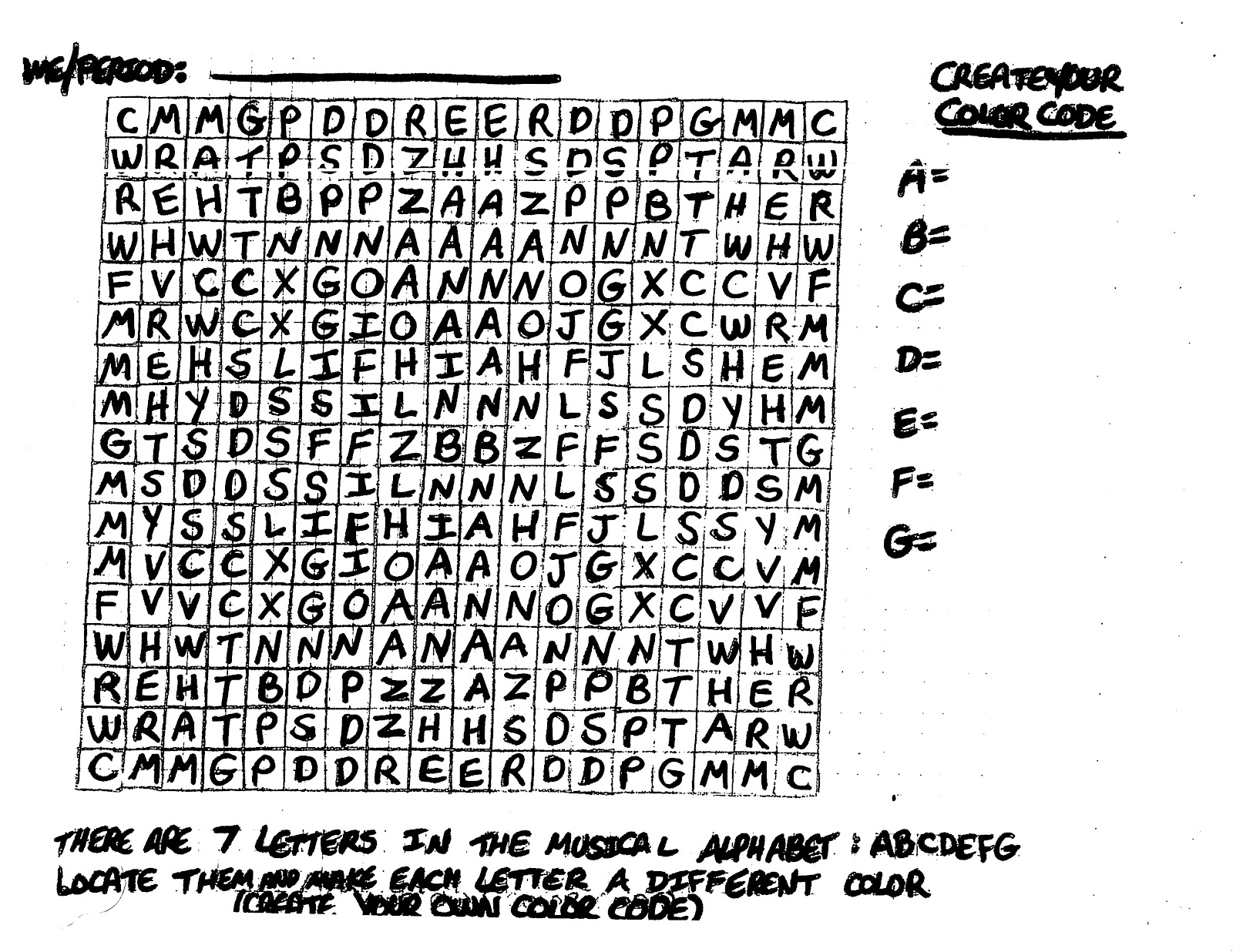
....MUSICAL ALPHABET GRAPHING WORKSHEET(CONTINUED)
....1. Sheet #2: Students will determine the direction of the musical alphabet at the beginning of each graph and complete 

         the musical alphabet in the proper direction. Colors (one for each of the 7 letters) will be added in as before. (Sheet 
         #3 is extra credit. It is similar to Sheet #2)
....2. Sheet #4: Finding patterns

........a. Patterns are found in music everywhere; often there are patterns within patterns. This exercise is to give an idea 
            of how musical sounds are arranged to create anywhere from simple to complex patterns.
........b. Musical patterns are mathematical try to find the mathematical formulas in each pattern.
........c. Locate the musical alphabet patterns in each pattern (forward or backwards).
........d. Using your color key as before color in the squares. The colors you see are also colors you hear.
(Tomorrow applying the musical alphabet on the keyboard.)

ADVANCED VIOLIN
OBJECTIVE: BOWING PROPORTIONS and "HARVEST FESTIVAL" MUSIC
....TUNING
....WARM-UP

........1. Cycle of Strings
..............a. Single Bows Upper Half (UH).
..............b. Single Bows Lower Half (LH).
..............c. Bow Proportioning (W=WHOLE/ UH=UPPER HALF/ LH=LOWER HALF)
..................1)Bow to the rhythm of the words "My Sis-ter Marc-y"
..................2)Perform the pattern 2x each string (note)
..................3)Start down bow and continue with the bowing as it comes
..................4)Use this pattern of bow proportions: W--UH-UH-W--W--/W--LH-LH-W--W--//
....NOTE READING REVIEW
........1. Review line-space musical alphabet rule to read the notes on the musical staff:
            A line to the very next space or a space to the very next line (step-wise motion) going up is one note higher in the 
            musical alphabet and a line to the very next space or a space to the very next line (step-wise motion) going                       down 
            is one note lower in the musical alphabet.
........2. Review treble clef note reading.
............a. Treble Clef is often called the "G" clef because it is a symbol which looks like a fancy "G" and because the 
                circle portion of the "G" goes around line 2 of the music staff which is the line that represents the note "G"
........3. Review bass clef note reading.
.............a. Bass Clef is often called the "F" clef because it is a symbol that looks like a fancy "F" and because the two 
                 small dots (which help create the look of the"F") located above and below line 4 of the music staff are 
                 emphasizing (or in a way) pointing towards line 4 which represents the note "F."
....SONG: "HASTE TO THE WEDDING"
........1. For sight reading and review everyone will read the double bass part (music is prepared for the different 
            instrumentations in the proper clefs for each instrument.)
............a. First read the notes out loud.
............b. Play with the accompaniment.
This to be continued tomorrow.


BEGINNING VIOLIN
OBJECTIVE: RHYTHMIC INTRODUCTION

....APPLICATION OF QUARTER NOTES, QUARTER NOTE RESTS, EIGHTH NOTES IN PAIRS IN A RHYTHMIC SONG: "ALLEY CAT" (CONTINUED)
........1. Review counting of quarters, quarter rests, eighth notes in pairs.
........2. Introduce concepts of:
............a. Meter: The mathematical formula at the beginning of a piece of music which determines the amount of beats in                   a musical section or measure
............b. Measure: A section of music, measured by a mathematic formula given by the meter.
............c. Bar Line: The line(s) that divides the music notation into sections or measures.
............d. Measures Rest: A symbol for a measure of rest (a section of the music not played by a particular instrument) 
                with a number above it indicating more than 1 measure of rest. (In "Alley Cat" the music begins with 4 
                measures of rest.)....EXTENSION OF "ALLEY CAT" RHYTHMIC SONG:
........1. After learning the left and right body percussion directions from the last lesson the body percussion will be 
             replaced with percussion instruments:
..............a. Left hand body percussion becomes wood sounding instruments (indicated by notes being the color black).
..............b. Right hand body percussion becomes scraping instruments (indicated by notes being the color red).
..............c. Triangles added at certain locations (indicated by a blue colored "X") replacing some quarter rests.
........2. Students count all the notes but only play on their specific instrument's color. 
..............a. It is encouraged for students to count out loud as they play to help keep a focused concentration.
........3. Teacher points to the notes to help with tracking. (Student volunteers then become pointers to help class track.)
........4. Students perform rhythmic song without tracking help; each student responsible to count for themselves while 
             playing with the accompaniment.
(Tomorrow a little look at violin history and starting to learn the parts of the instrument.)

Thursday, September 1, 2011

WHAT WE DID TODAY 2011-2012: SEMESTER #1 THURSDAY; SEPTEMBER 1, 2011

GENERAL MUSIC periods 1,2,3
OBJECTIVE: MUSICAL ALPHABET
....ROLL
....PROCEDURES/CLASS FOLDERS TO HOLD CLASSWORK

....WHAT IS BODY LANGUAGE WORKSHEET/DISCUSSION/PRACTICE
........01. Finish as needed

.....MUSICAL ALPHABET INTRODUCTION
........01. Art and Music Connection: Artists use colors as their medium of expression musicians use sound
..............a. Colors you visually see start with primary colors which are then mixed into secondary colors and further 

                   mixed into many other varieties or shades
...............b. Music also has primary pitches or TONE COLORS which also can be blended to form different sounds

........02. Using the keyboard as an example the primary musical tone can be demonstrated.
...............a. On the keyboard pressing down individual keys produces different sounds (TONE COLORS)
...............b. The keys are arranged in patterns which can be clearly identified by viewing how the black and white keys are 

                   situated. You can see and hear the patterns
...............c. Identify the patterns of the black keys? Identify the pattern of the white keys. How many keys are in each 
                    pattern? How many black and white keys (together) are in one pattern? 
...............d. Playing the patterns it is easy to hear them. The patterns are repeated over and over again going higher as the 
                   keys are played going up to the right and lower when moving down to the left. 
...............
e. There are actually 88 keys on a full sized piano but only 7 white keys, 5 black keys; combined together 12 

                   keys in a pattern on the keyboard.  
...............f. The musical keys are identified as colors are in art. The names given to each key in the pattern of 7 white keys 
                   (or sounds they represent) are most often the first 7 letters from the alphabet: "A B C D E F G" called the 
                   "musical alphabet." (The "DO-RE-MI" Solfege system is the second most common way of identification.)
...............
g. Since the 5 black keys derive their names from the white keys the names of the white keys are learned first
.
........03. Memorizing the notes of the musical alphabet forwards and backwards [because music sounds will go higher (up 

                or forward) and lower (down or backwards) one of the basic foundations of music.
...............a. Thinking versus Memory: You can memorize something but not understand it and you can understand 
                    something but not have it totally memorized. Though the two processes work together they are different.
....................1)For performance musicians need to have their music learned as an "automatic reflex" in order to place all 

                        their attention on the emotional and tonal aspects of the whole piece. 
....................2)
Thinking while performing has the musician looking at the individual parts separately from the whole and 

                        that takes away the musicality. 
....................3)
The ability to play fast musical passages are also impeded by thinking

.....................4)In music nothing is totally learned until it has become an automatic reflex
...............b. Memorize the 7 letters of the musical alphabet forward by chanting it to a steady patsch (a patting of the thighs 
                   with the palms of the hand) pulse over and over accenting (or stressing) the "A" a little louder to feel the 
                    pattern of the 7 letters. (Keep repeating this exercise at faster paces.)
....................1)
Since the regular alphabet going forward is an automatic reflex for most everyone, this is easy to do.
...............c. Memorize the 7 letters of the musical alphabet backwards by chanting it to a steady patsch (a patting of the 

                   thighs with the palms of the hand) pulse over and over starting with letter "G" and accenting (or stressing) the 
                   "G" a little louder to feel the pattern of the 7 letters. 
...................1)This may be more difficult because many of us were never asked to learn our regular alphabet backwards 

                       and in order to do that requires us to think it through.
...................2)To be able to perform this from memory at a fast pace it must be learned as an automatic reflex by dividing 
                       the backwards musical alphabet into smaller, easier memorized sections or patterns and chanting them 
                       quickly accenting certain letter sounds to create a rhythm as if reciting a poem. [EXAMPLE: letters 
                       enlarged should be louder than the others "GFE" (repeat quickly 4x); "GFED" (repeat quickly 4x); "CBA" 
                       (repeat quickly 4x); "GFED" pause "CBA" (repeat quickly 4x); "GFEDCBA" (repeat quickly 4x)

ADVANCED VIOLIN 
OBJECTIVE: DIRECTIONS/PROCEDURES
....ROLL
....SEATING CHART
....PROCEDURES ON SET-UP/TAKE DOWN
........1. Practice and see if any procedural changes need to be made.
....OVERVIEW OF MUSIC FOR "HARVEST FESTIVAL" CONCERT
........1. "Haste to the Wedding"
........2. "Rocky Top"
....MUSIC FOLDER PREPARATION


BEGINNING VIOLIN
OBJECTIVE: BODY LANGUAGE/FOLLOWING A CONDUCTOR
....ROLL
....PROCEDURES/SEATING CHART
....WHAT IS BODY LANGUAGE DISCUSSION
........01. Body Language: What is it? Why is it needed in the orchestra? Demonstrate some examples.
........02. Silence: What is it? How is it used in music? Is there ever complete silence?
..............a. Sound does not become music without silence (the planned spaces between the sounds)
..............b. Music is a combination of sound and silence the most difficult part being the performance of the silences especially in a group of musicians.
..............c. Mistakes in the creation of musical sounds are able to be covered up in group playing but all mistakes are heard if someone in the group plays in the silence.
..............d. Learning to create the silence is a skill that takes training as it takes much control and focus to accomplish.
........03. Listening versus Hearing: What is the difference?
..............a. There are so many sounds around us that in order to function we have learned to block many of them out to where we have forgotten that our hear capacity is much greater than we know.
..............b. Listening deals with the process of intense focusing; an element essential for the musician
........04. Teams: An orchestra is a team. What other groups are teams?
........05. Teamwork: What is it and why is it important for an orchestra?
........06. Leadership: What is a leader and why is his/her function in a team?
........07. Rules: What are they? Why are they important for a team?
........08. Conduct: What is it?
........09. Conductor: As the leader of the orchestra's conduct, what does he do? What are his/her rules?
 
....PRACTICING BODY LANGUAGE/FOLLOWING THE CONDUCTOR
........01. Importance of watching the conductor
........02. Review visual cues
........03. Demonstrate and practice the conductor's starting beat or "gravity" beat
              
(What goes up...will come down) so everyone learns to start together
........04. Practice with percussion instruments 
(after short demonstration of each instrument used) cues on how to:
..............a. stop/start
..............b. get louder/softer
..............c. faster/slower
..............d. how to 
stop with a silence that is not only heard but seen by an audience
(body movements are completely still until the conductors hands go down)