"Our attitudes control our lives. Attitudes are a secret power
working twenty-four hours a day, for good or bad. It is of
paramount importance that we know how to harness and
control this great force."
AUTHOR: Irving Berlin

"What you feel inside will control
your entire life on the outside."

 |
Judith Leyster: Young Flute Player
|
NINE CONCERTOS
for TRANSVERSE FLUTE
Barthold Kuijken, Flute and Conductor
Academia Montis Regalis
I. Concerto for Transverse Flute, Strings and Basso Continuo
in E minor RV 432
II. Concerto for Transverse Flute, Strings and Basso Continuo
in G major RV 436
III. Concerto for Transverse Flute, Strings and Basso Continuo
in D major RV 429
IV. Concerto for Transverse Flute, Strings and Basso Continuo
in A minor RV 440
V. Concerto for 2 Transverse Flutes, Strings and Basso Continuo
in C major RV 533
VI. Concerto for Transverse Flute, Strings and Basso Continuo
in G major RV 438
VII. Concerto for Transverse Flute, Strings and Basso Continuo
in G major RV 438 "bis"
VIII. Concerto for Transverse Flute, Strings and Basso Continuo
in D major RV 427
IX. Concerto for Transverse Flute, Strings and Basso Continuo
in E minor RV 431

BAROQUE
TRANSVERSE FLUTE
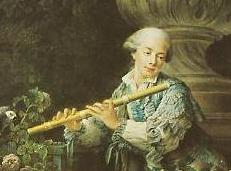

A revolution in flute
making took place in
the second half of the
Baroque 17th century
and was named traverso
(now also known as traverso).
This flute had significant modifications
from earlier renaissance models including
a conical bore, the addition of a key for the
right hand little finger, and a more ornate
body made in several pieces. The instrument
was now fully chromatic because of the
added key and thus was better suited for a
role as a solo instrument. The change in the
bore made a big difference in it's sound by
improving the instrument's intonation and
increasing the volume in the lowest notes; a
great asset for soloing capabilities. The bore
change also allowed the finger holes to be
placed higher on the tube, making the instrument
slightly easier to handle especially with smaller
hands than a renaissance flute at the same pitch.
making took place in
the second half of the
Baroque 17th century
and was named traverso
(now also known as traverso).
This flute had significant modifications
from earlier renaissance models including
a conical bore, the addition of a key for the
right hand little finger, and a more ornate
body made in several pieces. The instrument
was now fully chromatic because of the
added key and thus was better suited for a
role as a solo instrument. The change in the
bore made a big difference in it's sound by
improving the instrument's intonation and
increasing the volume in the lowest notes; a
great asset for soloing capabilities. The bore
change also allowed the finger holes to be
placed higher on the tube, making the instrument
slightly easier to handle especially with smaller
hands than a renaissance flute at the same pitch.
 |
| http://www.flutesbaroques.com/rippert_ang.php |
Some famous manufacturers of this type of
flute were Jean-Hyacinth Rottenburgh (1672-
1756) and Carlo Palanca (1690-1783) making
instruments that were played by both professional
and amateurs musicians. Among the professionals
were Johann Joachim Quantz
flute were Jean-Hyacinth Rottenburgh (1672-
1756) and Carlo Palanca (1690-1783) making
instruments that were played by both professional
and amateurs musicians. Among the professionals
were Johann Joachim Quantz
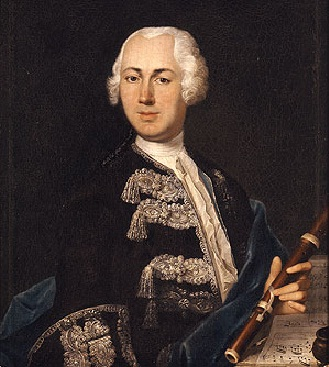 |
| Johann Joachim Quantz (1697-1773) |
flutist at the court of Frederick II of Prussia
 |
| Adolph von Menzel: The Flute Concert of Sanssouci, 1852 (depicts Frederick II playing the flute in his music room at Sanssouci palace with Carl Philipp Emanuel Bach on the Harpsichord and Frantisek Benda on the Violin) |
and famous flute teacher.
Quantz wrote a major treatise
on traverso flute technique.

The transverse flute was
so popular in the 18th
century that this new,
flexible instrument not
only dethroned the

but one Amsterdam
publisher asked Vivaldi in
1725 to provide six concerti for
distribution. From his many hundreds
of works Vivaldi chose five, some originally
for recorder with some dating back to 1703.
He arranged these for flute and string orchestra
and wrote another to make six. This collection
was issued in 1728 as the famous Op.10.
SIX FLUTE CONCERTOS OP. 10
for Flute, Strings and Basso Continuo
Stephen Preston, Flute
Christopher Hogwood, Conductor
Academy of Ancient Music
I. Concerto for Flute, Strings & Continuo in F major
["La tempesta di mare"]
Op. 10/1, RV 433
[Allegro/Laro/Presto] 0:08

II. Concerto for Flute, Strings & Continuo in G minor
["La Notte"],
Op. 10/2, RV 439
[Largo/Presto (Fantasmi) - Largo/Presto/Largo (Il sonno)/Allegro] 6:43
["La tempesta di mare"]
Op. 10/1, RV 433
[Allegro/Laro/Presto] 0:08
II. Concerto for Flute, Strings & Continuo in G minor
["La Notte"],
Op. 10/2, RV 439
[Largo/Presto (Fantasmi) - Largo/Presto/Largo (Il sonno)/Allegro] 6:43
III. Concerto for Flute, Strings & Continuo in D major
["Il gardellino"],
Op. 10/3, RV 428
IV. Concerto for Flute, Strings & Continuo in G major,
Op. 10/4, RV 435
V. Concerto for Flute, Strings & Continuo in F major,
Op. 10/5, RV 434
VI. Concerto for Flute, Strings & Continuo in G major,
Op. 10/6, RV 437
in music history wrote music of excellent quality for
the Baroque transverse flute among them
 |
| Georg Friedrich Handel (1685-1759) |
 |
| Johann Sebastian Bach, (1685-1750) |
 |
| Michel Blavet (1700-1768) |
and also Quantz.
 |
| Julius Henricus Quinkhard: A Violinist and a Flutist Making Music |




.jpg)


