Showing posts with label MAY 2013. Show all posts

Friday, May 31, 2013

FRIDAY, MAY 31, 2013

QUOTE:
"Music is a friend of labor for it lightens the task by 
  refreshing the nerves and spirit of the worker."
AUTHOR: William Green
MEANING OF THE QUOTE:
“The rhythmic beats of music not only help people pace
  their daily work activities but also make the work more 
  enjoyable." 


COMPOSER
MENDELSSOHN


Elijah
Cranach: Elijah and the Priests of Baal 1545
Elijah or Elias was a famous prophet and a wonder-worker in the northern kingdom of Israel 
during the reign of Ahab, according to the Biblical Books of Kings.


ARTICLE FROM:
Irving S. Gilmore Music Library

Mendelssohn’s first oratorio, St. Paul (1836), achieved such an extraordinary success that it was a difficult act to follow. Mendelssohn immediately began contemplating the possibility of a second oratorio, and he even considered setting the story of Elijah. But for nearly a decade, these plans remained unfulfilled. He was apparently thinking about Elijah again in 1845, and when the Birmingham Music Festival commissioned him to compose an oratorio, he was ready to get to work. 

As he had with St. PaulMendelssohn asked Julius Schubring, a friend and Lutheran pastor, to assemble a libretto from the German Bible. Because the audience in Birmingham expected an English-language oratorio, Schubring’s text had to be translated. Although Mendelssohn spoke English himself, he entrusted this assignment to his friend William Bartholomew. It was sometimes a delicate task, because many of the Biblical passages were famous ones, so English listeners would have been dismayed if they had heard literal translations of Luther’s German Bible rather than the King James version that was so familiar in England.

The premiere took place in Birmingham on August 26, 1846, under Mendelssohn’s direction. It was a tremendous success, and ever since Elijah has been widely regarded as the pre-eminent oratorio of the 19th century. 

Today we usually think of Mendelssohn as the composer of two oratorios, but he was already at work on a third, Christus, when he died in 1847 at the age of only 38.


GENERAL MUSIC
01. VIOLIN INSTRUCTIONAL DOCUMENTARY "SMALL WONDERS" CONTINUED
http://missjacobsonsmusic.blogspot.com/2009/12/small-wonders-concert.html
.......a.  TECHNIQUES OF PLAYING VIOLIN EXPLAINED
.......b.  METHODS OF TEACHING VIOLIN DEMONSTRATED

ADV. STRINGS
SPRING CONCERT FOR SCHOOL DURING LUNCH
JUNE 5th 5:00 PM (4:30 CALL TIME) DEDICATION FOR PATRICK'S GARDEN 
VOLUNTARY PARTICIPATION TO PLAY "STAIRWAY TO HEAVEN"

BEG. STRINGS
SPRING CONCERT FOR SCHOOL DURING LUNCH

Thursday, May 30, 2013

THURSDAY, MAY 30, 2013

QUOTE:
"Music can noble hints impart,
  Engender fury, kindle love,
  With unsuspected eloquence can move,
  And manage all the man with secret art."

AUTHOR: Joseph Addison
MEANING OF THE QUOTE:
“Music specializes in communicating the deepest feelings of mankind."


COMPOSER
MENDELSSOHN

Symphony No. 4 in A Major "Italian"
Conductor: Otto Klemperer

The city of Florence, Italy painted by Felix Mendelssohn
Symphony No. 4 in A Major "Italian"
Conductor: Gustavo Dudamel

GENERAL MUSIC
01. VIOLIN INSTRUCTIONAL DOCUMENTARY "SMALL WONDERS"
http://missjacobsonsmusic.blogspot.com/2009/12/small-wonders-concert.html
.......a.  TECHNIQUES OF PLAYING VIOLIN EXPLAINED
.......b.  METHODS OF TEACHING VIOLIN DEMONSTRATED

ADV. STRINGS
SPRING CONCERT (THURSDAY; MAY 30TH) PREPARATION
JUNE 5th 5:00 PM (4:30 CALL TIME) DEDICATION FOR PATRICK'S GARDEN 
VOLUNTARY PARTICIPATION TO PLAY "STAIRWAY TO HEAVEN"
01.  SET UP FOR SPRING CONCERT PERIOD 4
02.  DRESS REHEARSAL PERIOD 6

BEG. STRINGS
SPRING CONCERT (THURSDAY; MAY 30TH) PREPARATION
01.  SET UP FOR SPRING CONCERT PERIOD 4
02.  DRESS REHEARSAL PERIOD 6

Wednesday, May 29, 2013

WEDNESDAY, MAY 29, 2013

QUOTE:
"Music, when soft voices die,
  Vibrates in the memory"
AUTHOR: Percy Bysshe Shelley

MEANING OF THE QUOTE:
“Music resides in your memory long after it is heard."


COMPOSER
MENDELSSOHN
Stained glass 'Mendelssohn' window in the Thomaskirche in Leipzig
http://www.bbc.co.uk/composers/mendelssohn/pictures/08/


A Midsummer Night's Dream:

Overture Opus 21 

Conductor:  Kurt Masur (1997)

Arthur Rackham: Act III, scene i: Fairies

Arthur Rackham: Titania Queen of the Fairies
The Overture in E major, Op. 21, was written in 1826 by Mendelssohn at 17 years and 6 months old near the start of his careerIt was written as a concert overture and originally not associated with any performance of the play. The Overture was written after Mendelssohn had read a German translation of the Shakespeare 
play A Midsummer Night's Dream In 1842, only a few years before his death, he received a commission from King Frederick William IV of Prussia to write some music for a Potsdam production of the play of A Midsummer Night's Dream to which he wrote incidental music (Op. 61) into which he incorporated the earlier existing Overture. The incidental music includes the world-famous Wedding March. The German title reads Ein Sommernachtstraum
Shakespeare
Wedding March
from the incidental music for "A Midsummer Night's Dream" Op. 61

It wasn't until Jan. 25, 1858, that the march first appeared in a royal wedding as a recessional (commonly performed as the bridal party files out at the end of the service) used by princess Victoria, The Princess Royal (the oldest child of Queen Victoria) when she married Prince Frederick William of Prussia.  The event was enough to set a standard for ages to come and after this it became popular at weddings. 
 Princess Victoria Royal Marriage January 25,1858
Queen Victoria and her husband Albert were very fond of Mendelssohn and loved to spend afternoons playing the composer's "Songs Without Words" and singing selections from his oratorios. Mendelssohn often used to play for the royal family while on his visits to Britain.
Prince Albert played the organ in the Old Library in Buckingham Palace
in the presence of Queen Victoria and Felix Mendelssohn (1842)

 Incidental Music from A Mid Summer 

Nights Dream Op. 61 (complete)
Conductor: Arturo Toscanini, 1942

http://kidsmusiccorner.co.uk/composers/classical/mendelssohn/
http://mendelssohnsworld.blogspot.com/2009/09/another-way-of-listening-to-midsummer.html

GENERAL MUSIC
01. THEORY
.......a.  FINISHED THE NEXT NOTE READING TREBLE CLEF PUZZLE
02. VIOLIN
.......a.   LEFT PIZZICATO SONG: CRIPPLE CREEK
.............1.  LOOKED OVER MUSIC NOTATION OF OPEN STRINGS
..................a.  OPEN STRING NOTES COLORIZED TO AID IN LEARNING
..................b.  REVIEWED TREBLE CLEF NOTE READING
..................c.  MADE CONNECTION BETWEEN NOTES and OPEN STRINGS
..................d.  CLASS SANG LETTER NOTE NAMES AS THEY LISTENED TO THE RECORDED ACCOMPANIMENT
..................e.  STUDENTS REPEATED THE ABOVE and ALSO USED LEFT HAND PIZZICATO TO PLUCK THE 
                       NOTES THEY WERE SINGING

ADV. STRINGS
SPRING CONCERT (THURSDAY; MAY 30TH) PREPARATION
JUNE 5th 5:00 PM (4:30 CALL TIME) DEDICATION FOR PATRICK'S GARDEN 
VOLUNTARY PARTICIPATION TO PLAY "STAIRWAY TO HEAVEN"
01.  REVIEWED DIRECTIONS FOR THURSDAY'S CONCERT and REHEARSAL
02.  TOOK EQUIPMENT TO THE CAFETERIA FOR SET-UP TOMORROW

BEG. STRINGS
SPRING CONCERT (THURSDAY; MAY 30TH) PREPARATION
01.  REVIEWED DIRECTIONS FOR THURSDAY'S CONCERT and REHEARSAL
02.  TOOK EQUIPMENT TO THE CAFETERIA FOR SET-UP TOMORROW

Tuesday, May 28, 2013

TUESDAY, MAY 28, 2013

QUOTE:
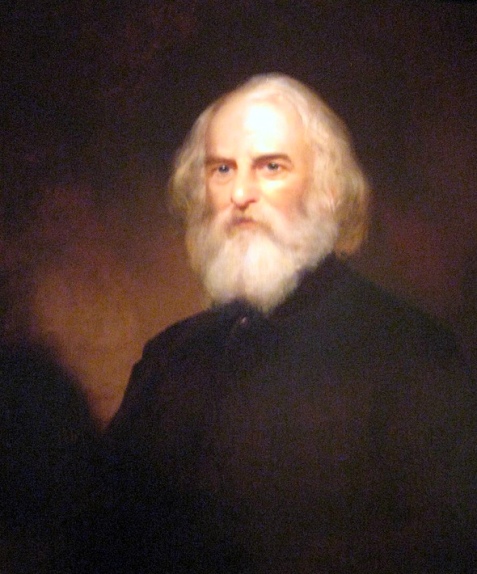
"Music is the universal language of mankind.
AUTHOR: Henry Wadsworth Longfellow

MEANING OF THE QUOTE:
“No matter what language you speak you can still communicate to anyone 
  your feelings through music."


COMPOSER
MENDELSSOHN

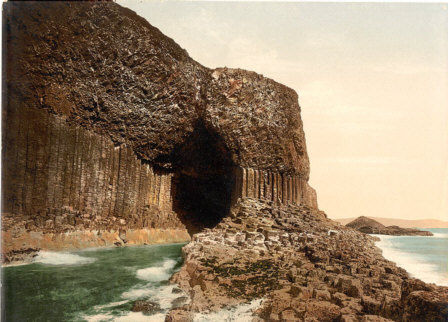
Hebrides Overture "Fingal's Cave"


Overture, The Hebrides (Fingal's Cave), Op. 26      Felix Mendelssohn Bartholdy(1809-1847)

INFORMATION FROM: http://www.civicsymphony.org/Programs.html
October 10, 1993 - Program Notes by Thomas G. Rigney
Mendelssohn visited the Hebrides, islands off the west coast of Scotland, in 1829 as part of a summer vacation. One of the attractions there was a huge cavern on the island of Staffa, Fingal's cave. Upon his return to Germany he began writing the overture and completed it in 1832. It was premiered with the London Philharmonic Society with Thomas Attwood conducting and received great reviews from the critics. Even Richard Wagner, one of Mendelssohn's biggest critics, later described the work as "one of the most beautiful pieces we possess." It should be noted that the purpose of the work was not to be a tone poem, but rather as a reaction to an event, as in the Beethoven "Pastoral" symphony.

The overture opens with lower strings and bassoons playing the main theme, which is evocative of the waves of the sea. This theme is repeated in the violins. A second theme is introduced in the cellos and clarinets as a variant to the main theme. Dialogue between the strings and winds of the main theme leads back to the opening texture. The piece ends with a calm subsiding of the orchestra to silence, as if the motion of the sea itself has come to a rest.


J. M. W. Turner(artist) Staffa, Fingal's Cave, 1832 
The poet John Keats 

visited Staffa, Fingal's Cave in 1818 (Mendelssohn went in 1829) and he wrote a poem about it called 'Staffa.' The following is a section of the poem describing the natural music made by the power of nature heard in the cave:


This was architectur'd thus
By the great Oceanus! - 
Here his mighty waters play
Hollow organs all the day; 
Here by turns his dolphins all,
Finny palmers great and small,
Come to pay devotion due - 
Each a mouth of pearls must strew. 
Many a mortal of these days, 
Dares to pass our sacred ways, 
Dares to touch audaciously 
This Cathedral of the Sea! 
I have been the pontiff-priest 
Where the waters never rest, 
Where a fledgy sea-bird choir 
Soars for ever; holy fire 
I have hid from mortal man; 
Proteus is my Sacristan.

GENERAL MUSIC
01. THEORY
.......a.  STARTED THE NEXT NOTE READING PUZZLE (TO FINISH TOMORROW)
02. MAKING MUSICAL INSTRUMENTS PROJECT
.......a.  COMPLETED LAST OF PRESENTATIONS
03.  VIOLIN
.......a.   LEFT PIZZICATO 
.............1.  CYCLE OF STRINGS PLUCKING EACH STRING 4X WITH EACH FINGER OF LEFT HAND
.............2.  EXERCISE USED TO DEVELOP LEFT VIOLIN ANGLE, LEFT ARM UNDER THE VIOLIN, and 
                  TO STRENGTHEN THE LEFT HAND FINGERS

ADV. STRINGS
SPRING CONCERT (THURSDAY; MAY 30TH) PREPARATION
JUNE 5th 5:00 PM (4:30 CALL TIME) DEDICATION FOR PATRICK'S GARDEN 
VOLUNTARY PARTICIPATION TO PLAY "STAIRWAY TO HEAVEN"
01.  REVIEWED DIRECTIONS FOR THURSDAY'S CONCERT and REHEARSAL

BEG. STRINGS
SPRING CONCERT (THURSDAY; MAY 30TH) PREPARATION
01.  REVIEWED DIRECTIONS FOR THURSDAY'S CONCERT and REHEARSAL

Friday, May 24, 2013

FRIDAY, MAY 24, 2013

QUOTE:
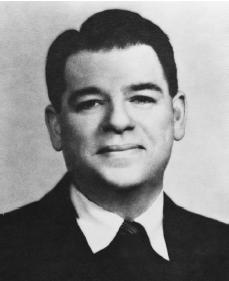
"All the sounds on the earth are like music."

AUTHOR: Oscar Hammerstein Jr.
MEANING OF THE QUOTE:
“Music is all around us; the wind, ocean pulse, and from the birds that sing….if you only
  listen for it.”


COMPOSER
JOPLIN
http://johnjay.jjay.cuny.edu/acalendar/EventList.aspx?view=EventDetails&eventidn=
4598&information_id=13126&type=&rss=rss
 Treemonisha Overture Act I

 Treemonisha (Ragtime Opera)
Frolic of the Bears from Treemonisha 


LINKS
http://javanese.imslp.info/files/imglnks/usimg/1/11/IMSLP12807-Joplin_Treemonisha_No.13_FrolicOfTheBears.PDF
The end of the 19th century saw the rise of ragtime, a heavily syncopated music form that had its roots in African-American music. It was a time when new music was distributed through printed scores.

Treemonisha (1910/1972) is an opera opera in three acts (named after the heroine) composed by the famed African-American ragtime composer Scott Joplin. Though there are jaunty ragtime songs and dances, 
(the reason why Treemonisha is incorrectly often referred to as a "ragtime opera"), Joplin did not refer to it as such. He intended it as a serious American grand opera, like that of the European opera, with an extensive overture,  an overture.  Following the traditional rules of operatic writing, in the Overture Joplin patches together the main themes of Treemonisha; each of them has a symbolic meaning and/or is associated with a character, an environment or an episode. Those who ignore the opera libretto can therefore miss out on
the hidden meaning of the Overture: it foreshadows the fight between good and evil, between the light of reason and the darkness of superstition, which is at the core of the opera. There is are also instrumental preludes to the second and third acts, along with various recitativeschoruses, small elaborate ensemble pieces, a ballet, and a few formal arias with elements of black folk songs and dances, including a kind of pre-blues music, alongside spirituals, and a call-and-response gospel elements (as in a scene involving a congregation and preacher). Its polarity of thought, assimilated black identity and the influence of classic European opera of the Eighteenth century are distinctive.

With a libretto by Joplin, Treemonisha, is a story of the triumph of education and enlightenment over superstition and ignorance among the African American population of the Texarkana region of Arkansas in the late 1800s. The story is set in September 1884 on a remote former slave plantation in Arkansas surrounded by an isolated dense forest between Joplin's childhood town Texarkana and the Red River in Arkansas. The opera takes place in the south only one year after the end of the Civil War (1861-1865) that resulted in the abolition of slavery.  It tells of Treemonisha, an 18-year-old woman, the adopted child of ex-slaves, Monisha (mezzo-soprano) and Ned (bass) who find a baby under a tree. They adopt her and decide to name her Treemonisha. The child is sent away for an education and taught to read by a white woman (in exchange for Monisha washing and ironing clothes). When she later comes home she returns to a community riddled with superstition and witchcraft.

A band of conjurers tries to sell a “bag of luck” to her gullible mother, Treemonisha intervenes and banishes them. There are complications when the conjurers, who are losing their hold on the uneducated laborers of the plantation, capture Treemonisha and threaten to throw her into a wasp's nest. At the last minute, with the help of her friend Remus (tenor), Treemonisha is rescued and brought home. The opera ends with Treemonisha calling for the forgiveness of her captors. All the villains of superstition are forgiven.  Her proud parents, Ned and Monisha, and the laborers on the plantation celebrate Treemonisha as their leader in a wistfully tender final ensemble and dance, “A Real Slow Drag.” The community realizes the value of education and the liability of their ignorance before choosing her as their teacher and leader.  The story is an early voice for modern civil rights causes and most notably her character stresses the importance of literacy, learning, hard work, and community solidarity as the best formula for the advancement of the African-American population.

Treemonisha was completed in 1910, twenty-five years before the landmark black opera "Porgy and Bess" by George Gershwin. Joplin completed the opera in the vocal-piano presentation (with notes about the orchestration, along with Joplin's first opera A Guest of Honor 1903, were lost) and paid for the score to be published in 1911.  At the time of the publication, he sent a copy of the score to the American Musician and Art Journal and received a glowing, full-page review in their June issue. The review called it an "entirely new phase of musical art and... a thoroughly American opera (style)," which fit in well with Joplin's desire to create a distinctive form of African-American opera. Despite this endorsement and was said to contain some of his best music there was only one theater who agreed to produce it, after viewing a concert performance read-through with Joplin at the piano in 1915 at the Lincoln Theater in Harlem, New York, but the backers reneged.  Joplin became obsessed with Treemonisha at the end of his life, desperately trying to convince publishers to print it.  His dream of staging Treemonisha eluded him, and he died having only seen a run-through
with the piano accompaniment. The opera was not performed in full until 1972.

Aside from a concert-style performance in 1915 of the ballet from Act II, Frolic of the Bears by the Martin-Smith Music School, the opera was forgotten until 1970 when the piano score was rediscovered.  Also in the 1970's there was renewed interest in ragtime after the hit movie "The Sting" opened the world's ears to Scott Joplin's music leading to Treemonisha being staged in its entirety for the first time in 1972 using the orchestration by
T.J. Anderson. Subsequent performances have been produced using several versions of orchestrations created by a variety of composers including Gunther Schuller and most recently,  Rick Benjamin.

Gunther Schuller orchestrated and conducted a production with extreme care taken toward giving it an authentic sound based on the instruments and trends of its own day. But that version did not sound right to Rick Benjamin, an expert in late 19th and early 20th century music who found it "too heavy." Benjamin spent much of the last five years reconstructing the "Treemonisha" score for a 12-piece theater pit orchestra of the kind Joplin and his peers wrote for and performed with.

Treemonisha may have mirrored details from Joplin's own life.  In the opera, the title character receives her education in a white woman's home.  Joplin taught himself music fundamentals on a piano in the white home where his mother,  a domestic, (similar to the character of Monisha, who agrees to wash and iron clothes for a white family, if the lady of the house would give Treemonisha an education) worked.   News of the little child Scott's amazing gifts filtered through to the white Texarkana, Texas community. A teacher (German-born music teacher Julius Weiss) volunteered to teach him piano and harmony. So important was this glimpse into education that Scott Joplin would forever believe that the black person's path to salvation lay in education.  Lottie Joplin (the composer's third wife) saw a connection between the character Treemonisha's wish to lead her people out of ignorance and a similar desire in the composer.  The opera Treemonisha is based on this belief, and it conveys this social message in a manner ahead of its time, using an 18-year-old woman as its heroine.

It took 64 years before the work was given its first full professional staging. In 1976, Joplin was posthumously awarded a Pulitzer Prize in 1974 for "contributions to American music."

GENERAL MUSIC
01. MUSICAL THEATER: "OLIVER"
.......a.  REVIEW OF WHAT WE HAVE VIEWED SO FAR
.......b.  CONTINUED

ADV. STRINGS
SPRING CONCERT (THURSDAY; MAY 30TH) PREPARATION
JUNE 5th 5:00 PM (4:30 CALL TIME) DEDICATION FOR PATRICK'S GARDEN 
VOLUNTARY PARTICIPATION TO PLAY "STAIRWAY TO HEAVEN"

BEG. STRINGS
SPRING CONCERT (THURSDAY; MAY 30TH) PREPARATION

Thursday, May 23, 2013

THURSDAY, MAY 23, 2013

QUOTE:
"Music is given to us with the sole purpose of establishing an order in things, including, and particularly, the coordination

  between man and time."
AUTHOR: Igor Stravinsky
MEANING OF THE QUOTE:
“Music is a way that man has emotionally recorded his history 
  throughout time.”


COMPOSER
JOPLIN
"Scott Joplin" by Jeff Sipe
http://alibi.com/art/11629/Hootenanny.html
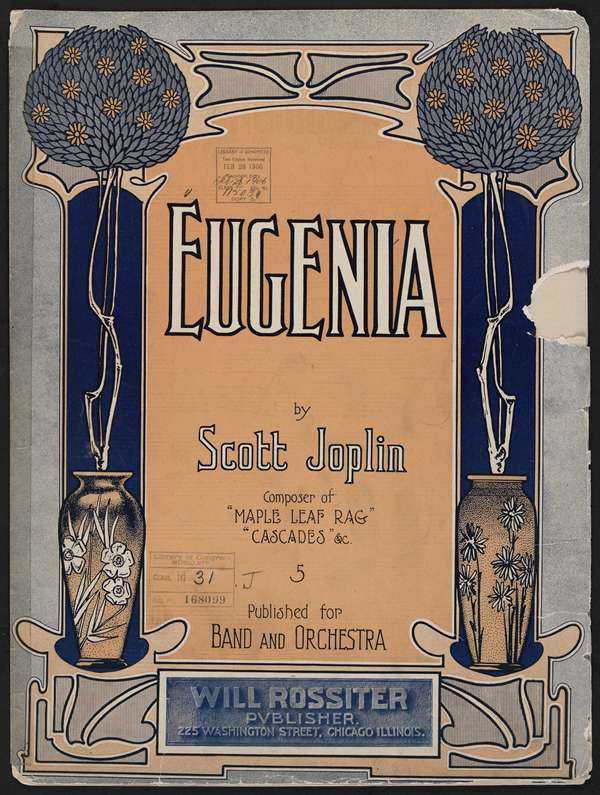
Eugenia

In spite of his use of the common cakewalk/march pattern of a repeated interlude in the C section, this rag, the Eugenia Rag (1906), transcends many old ideas.  Providing continuity, patterns of repeated bass octaves are present throughout the piece. The use of repeated phrases starting on off beats results in more interesting accumulative phrases.


http://www.mutopiaproject.org/ftp/JoplinS/eugenia/eugenia-let.pdf
http://www.mutopiaproject.org/ftp/JoplinS/eugenia/eugenia.mid


GENERAL MUSIC
01. THEORY:  TREBLE CLEF NOTE READING
.......a.  WORKED ON PAGE 4 OF THEORY BOOKLET
.......b.  PASSED BACK FIRST 3 PAGES THAT WERE GRADED
02.  INSTRUMENT MAKING DEMONSTRATIONS: DAY 4

ADV. STRINGS
SPRING CONCERT (THURSDAY; MAY 30TH) PREPARATION
JUNE 5th 5:00 PM (4:30 CALL TIME) DEDICATION FOR PATRICK'S GARDEN 
VOLUNTARY PARTICIPATION TO PLAY "STAIRWAY TO HEAVEN"

BEG. STRINGS
SPRING CONCERT (THURSDAY; MAY 30TH) PREPARATION
PRACTICE IN MR. ROA'S ROOM WITH THE CHOIR