Showing posts with label rests. Show all posts

Thursday, January 9, 2014

QUARTERS and EIGHTHS: ALLEY CAT RHYTHMIC PERCUSSION LESSON


"ALLEY CAT SONG" LESSONS
BODY PERCUSSION SONG "ALLEY CAT"

Utilizes form and rhythms of quarter notes, quarter rests, and eighth notes in pairs. 
This lesson can be extended into many lessons to cover many of the musical elements.

PREPARATION:
SILENT COMMUNICATION 
FOLLOWING A CONDUCTOR

BODY PERCUSSION
PREPARATION: ECHO RHYTHMS 

Play the audio of "Alley Cat"and while listening investigate:

FORM and PATTERNS

Student Generated Chart of "ALLEY CAT"

PERFORMANCE #1
.....1.  GRAPHING CHART INFORMATION
..........a.  A mathematical graph of the beats that visually shows the musical form. 
...............1)  "ALLEY CAT" FORM: Intro/A/A/B/A/CODA   
..........b.  Each square represents one "heart beat" in the music. 
...............1)  Music is ever present at all times in our bodies
..........c.  Compare FORM in music to: 
...............1)  Form in writing 
...............2)  A "sandwich" 2 pieces of bread (INTRO and CODA) with cheese and turkey in between
...............3)  Other things that have form (any other ideas?)
..........d.  Look for the colors to form many types of mathematical patterns (sometimes patterns within patterns).
...............1)  These visual patterns can also be heard (and quickly memorized) easily by the ear as patterns of sound.
.....2.  PERFORMANCE INFORMATION USING THE ALLEY CAT GRAPH CHART
..........a.  Each color is a different body percussion movement.
..........b.  Students to play with help of the teacher but then be able to follow the chart without that help.
...............1)  Students learn to track with their own eyes and listen to the patterns of sound on their own.


PERCUSSION INSTRUMENTS
PERFORMANCE #2
USING THE ALLEY CAT GRAPH CHART
REVIEW PERCUSSION INSTRUMENTS: NAMES and HOW THEY ARE PLAYED
.....1.  Exchange body percussion to instruments 
..........a.  Blue is any choice
..........b.  Wood sounds play the color yellow (A SECTION)  
..........c.  Scraper and shakers play pink (B SECTION)
.....2.  Students play with and without the help of teacher tracking
.....3.  Students exchange instruments and play different parts


SIMPLE RHYTHMIC NOTATION
QUARTER and EIGHTH RHYTHMIC PATTERNS INTRODUCTION


Student Generated Chart of "ALLEY CAT" RHYTHMS


ALLEY CAT RHYTHMIC CHART WITH QUARTER and EIGHTHS 
INTRO. TO BASIC RHYTHMS and their notation
.....1.  What is a quarter note?
..........a.  Generally the "heart beat" in music is called the quarter beat or "quarter note"
..........b.  An easy way to produce it is by the tap of a foot, a patsch on the leg, a clap of a hand, or a snap of a finger
..........c.  Verbally, there are many ways to produce it; an easy way is by saying (or thinking) the sound of "TAH"
.....2.  Is all sound music?
.....3.  What is silence? What is one of its function in music?
..........a.  Silence organizes sound into patterns; without silence the sound continues on without stopping like a drone.
..........b.  Silence in music is called a REST
..........c.  There is a relative REST for every type of played rhythmic note in music
.....4.  The length of sounds and silences can be musically notated using specific musical symbols based on fractions
.....5.  Eighth notes
..........a.  Splitting quarter notes in half produces a sound that is twice as fast
..........b.  Two eighth notes equal one quarter beat

PERFORMANCE #3
What is the difference between watching and focusing? 
(Review sitting still and having the eyes in focus BEFORE the music starts with "a moment of SILENCE") 
.....1.  Review note values and rhythm reading; how to perform a rest (which should be felt but not heard) 
.....2.  Perform using body percussion (any hand) while counting out loud in order to prevent "daydreaming" (losing focus) 
.....3.  Teacher will first point to help students track then have students focus without the help.

LEFT VS RIGHT
PERFORMANCE #4
Brain: Left Side/ Right Side and What It Has to Do With Music
.....1.  Explained that are bodies are "cross-circuited"
..........a.  Right side of the brain controls the left side and vice-versa
.....2.  Most everyone favors one side of the brain over the other that is why some people write with their right hand and some 
           with their left
..........a.  Few people can write equally well using right and left hands
..........b.  Equal use of both hands is called being "ambidextrous"
..........c.  In terms of certain skills controlled by one side of the brain, the other side is under developed
...............1)  To illustrate this point: print and write in cursive your name with the normal hand and then try the other
.....3.  What makes music unique compared to some other art forms is that most musicians need equal use of both hands in 
          order to create their art.
..........a.  An art teacher would probably not ask the student to draw using the weak hand, either would the English teacher 
               ask the student to hand write an essay using the weak hand; but in music the playing of most instruments requires 
               it.
.....4.  As the exercise in writing your name with the weak hand illustrates, the brain is trying extremely hard to send the 
          message to move the fingers, but the fingers cannot respond quickly (like the fingers on the strong hand does) 
..........a.  Frustration results when the brain knows how to do something but the muscles cannot respond at the same rate of 
               speed; this is the experience all musicians go through during music training (especially beginners).
..........b.  Actually this "frustration" is the brain expanding its capabilities (sort-of like the muscles aching when exercising 
               them; trying to build them up).
..........c.  Frustration thus is a good thing and all muscians experience this when learning something new.
.....5.  Playing music, learning to use both hands equally, forces the under-developed side of the brain to be used and thus 
          people who do this utilize more of their brain capacity
..........a.  I like to say, "Playing music makes a person smarter; the more of the brain you use the smarter you become."
.....6. Go over directions: why certain notes are colored red and some colored black (red notes and black notes have stems in 
          different directions as well)

Review
.....1.  The different colors indicated the use of right and left hands used to perform the rhythms in this body percussion 
           exercise.
.....2.  Using the left and right hands (not always in patterns) demonstrates the use of the right and left brain activity as 
           discussed earlier.
..........a.  Students will feel frustration or their brains' expanding as they perform this piece; especially when left-right 
               patterns are deliberately changed often near the end.
..........b.  As the brain functions by patterns, it rebels when new patterns are suddenly introduced to it.
..........c.   Forcing the brain to learn new patterns also expands the abilities of the brain's function.
.....3.  This exercise demonstrates the technique that a drummer (snare drummer) must go through when playing.
..........a.  Profession drummers plan their "sticking" (which hand plays which note at any given time) before practicing any 
               given piece. (Sticking is not random.)
.....4.  Since the performance of this is only rhythmic (no melody playing by the performer) in the beginning of the learning 
          process the ear cannot easily help out the eyes should the eyes get lost; so focus and concentration is more difficult in 
          drumming then on a melody instrument
.....5.  Perform with body percussion (BP) using a different color for each hand while counting out loud (best to say either 
           "left" or "right" in order to prevent getting the hands confused) for good focus. 
..........a.  Can perform this piece using percussion instruments instead of body percussion (BP).

ORCHESTRATION/PERCUSSION INSTRUMENTS
PERFORMANCE #5
Using the colored note chart: ALLEY CAT RHYTHMIC CHART (not the graphing chart)
.....1.  Pass out various percussion instruments (selection can vary/review each instrument briefly) : 
..........a.  slapstick
..........b.  tambourine
..........c.  cabasa
..........d.  guiro
..........e.  spoons
..........f.   claves 
..........g.  woodblock
..........h.  ratchet  
..........i.  maracas
..........j.  triangles
.....2.  Class discusses which instruments to use on specific notes and why (TERM: ORCHESTRATION) 
..........a.  Discussion of contrast between different sound colors or TIMBRES (like visual colors in art)
...............1)  Which instruments "shake" or "scrape" 
...............2)  Which instruments have metal sound qualities, wood sounds, etc.
..........b.  Discussion on how long each instrument can vibrate and how that determines the placement of the sound.
.....3.  Class/teacher determines which instruments to place on each color and/or symbol.
.....4.  Assign different instruments for red and black notes.  
..........a.  Colored "X" symbols are also added for use of the triangles.
.....5.  Review how to follow a conductor's silent cues (signals) and how to start and end together.

FOCUS
PERFORMANCE #6
Review PERFORMANCE #2 using "Uncolored" notes.  
.....1.  Stems on the notes will either be "up" to the right indicating the use of the "right" hand or stems "down" to the left 
           indicating the use of the "left" hand.  
..........a.  Please note the difficulty the eyes have staying focused.  Even though the concept of note reading may seem very 
               understandable the actual visual (physical) part can often be exhausting.


http://www.mediafire.com/download/al6123zglokalud/Alley+Cat+and+Chicken+Fat+v1.mp3

Wednesday, March 6, 2013

WEDNESDAY, MARCH 6, 2013

QUOTE:
“People compose for many reasons: to become immortal; because the pianoforte happens to be open; because they 
  want to become a millionaire; because of the praise of friends; because they have looked into a pair of beautiful eyes; 
  for no reason whatsoever.”
AUTHOR: Robert Schumann
MEANING OF THE QUOTE:
“People create art for varied reasons. For everyone the reason is different.”


COMPOSER
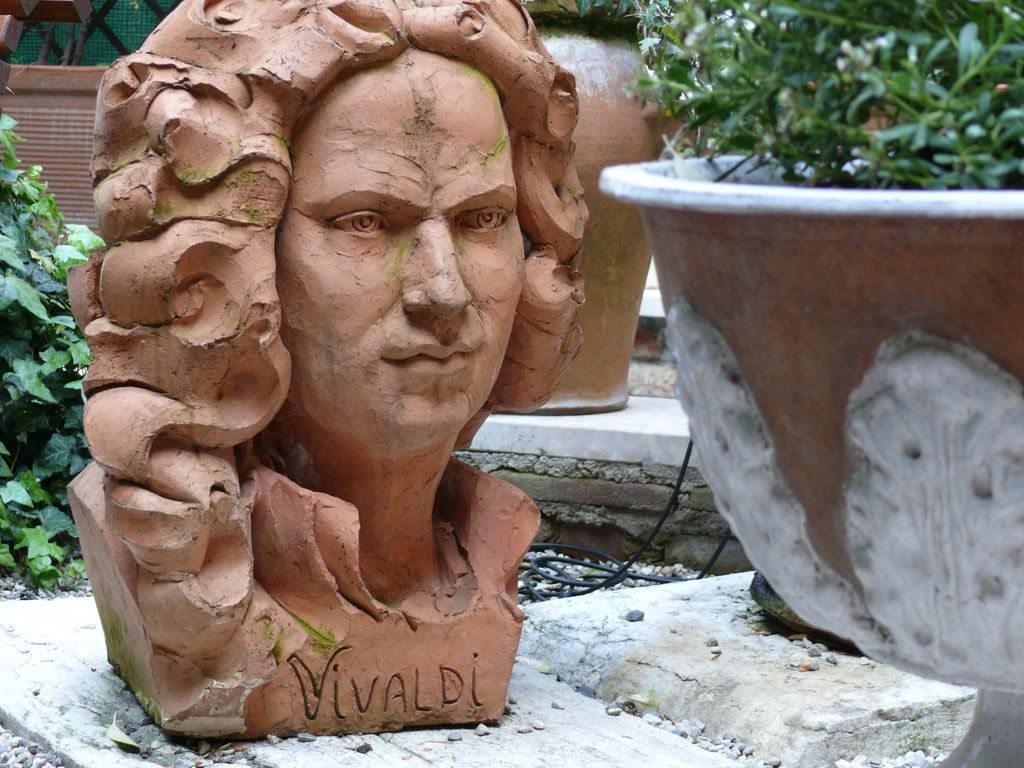
VIVALDI
http://s303.photobucket.com/user/SkipMcGrath/media/Vivaldi.jpg.html
DOUBLE TRUMPET CONCERTO
C MAJOR RV. 537 OPUS 46 NO. 1
Performed by Maurice Andre and Neville Marriner


Baroque Trumpet
Baroque Trumpet and Crooks
http://www.blemf.org/events/educational/brass.html
Natural Trumpet (top) Vs. Modern Valved Trumpet
http://music.yale.edu/2011/04/01/student-viewpoint-master-class-in-natural-trumpet/

ABOUT THE TRUMPET:


Bach to Basics

September 1, 2002


Natural trumpets. Trumpets made out of dirt and weeds? Wrong. They're made out of brass like any other trumpet.

"A natural trumpet is essentially a trumpet without valves," Bryan Proksch, a graduate student in musicology, or the study of the history of music, explains. He sits up straight and reaches for his trumpet case. The instrument that comes out of the case looks nothing like a modern trumpet—it is almost twice as long and has no valves.

On a modern trumpet, the three valves are connected to thin pieces of tubing. These little tubes connect to the larger tube that makes up the horn. However, the little tubes remain closed until the player presses a valve, which opens the passageway to a tube, elongating the path that the air travels. The longer the air path, the lower the sound that comes out of the horn. Proksch compares the phenomenon to blowing across a Coke bottle. The less liquid you have in the bottle, the longer the "air path," and the lower the resulting sound, because more air passes through it.

By using a combination of valves, a modern trumpeter can produce every note on a musical scale. The natural trumpet has no valves; instead, through subtle adjustments in lip tension, a natural trumpeter produces the notes of a harmonic scale, a set of selected tones that are "fixed by nature."

Proksch jumps up and grabs the telephone on his desk. He shakes the phone cord, creating a series of waves. "Imagine that one wave is equal to the note created using the smallest amount of lip tension. On a C scale—a series of eight notes beginning and ending with C—that note is C," he explains. He then shakes the cord harder and the waves double in frequency. The next note on the harmonic scale is "double" a C, or the C an octave higher. Shaking the cord even harder—the equivalent of adding more lip tension—creates a wave that is a fifth of the frequency of the original wave.

The natural trumpet evolved from the signaling trumpet, a single, straight tube about 47 inches long with a flared end. Aptly named, the signaling trumpet's splendid sound could be heard at great distances and was useful in military battles and royal fanfares. The natural trumpet performed similar functions as the signaling trumpet; however, instrument makers folded its 88 inches of tubing to make it more convenient to carry on military campaigns and to court functions.

The trumpet's function would have remained military if not for an important event in the trumpet's history: its acceptance into art music in the 17th century. The natural trumpet flourished during this time, with eminent composers such as J. S. Bach and Johann Schelle writing pieces in which trumpets led the melody. Valentine Snow was one such natural trumpeter for whom Handel wrote most of his music; Snow was also a composer, and Proksch recently edited a set of his natural trumpet duets, which was published by Brass Press.

Yet by 1770, composers such as Beethoven and Mozart had ushered in a more complex musical sound with several key changes in one piece. A natural trumpeter must change the instrument's mouthpiece in order to change keys. The impracticality of this requirement reduced the trumpet's role to opening flourishes and climaxes until the valve trumpet was invented around 1815. Unlike the natural trumpet, it can change keys without changing the mouthpiece and is easier to play in tune because it requires less lip tension.

Despite the pleasing, clear tone of the modern valve trumpet, Proksch insists that it is not what Bach and his contemporaries intended their robust and somewhat unrefined trumpet parts to sound like. Proksch's desire to play these pieces properly prompted him to learn how to play the natural trumpet. Better yet, he decided to make one. Even better, he decided to recruit other natural trumpeters in the hopes of creating a natural trumpet ensemble. Last spring, along with two undergraduate music majors, Derek Bittner and Edward Jakuboski, Proksch obtained a grant from the university to build six natural trumpets. Professor Leslie Leupp from the School of Visual Arts, the Department of Metal Arts, and Engineering Services assisted in the project by donating their facilities and materials.

"Making a natural trumpet is a lot simpler than you might think," Proksch says. Humming a Bach concerto, he riffles through some sheet music on the piano and finds scrap paper to draw on. "First," he says, "you cut a big sheet of brass." This piece will become the bell of the trumpet. He sketches a pattern of a trumpet bell that is about a yard long and looks as if it has been run over by a truck. He continues, "Next, cut out the pattern and make teeth marks along the two long sides." The two sides will eventually be connected; the interwoven teeth create a stronger fit than if two straight sides were simply welded together. Now, fold the pattern in half lengthwise and open it slightly at one end to fit on a mandrel, a big piece of curved steel. Finally, hammer out the bell into its proper curved shape.

Smaller brass tubes make up the rest of the natural trumpet. The joints are pressure-fitted by tapering the end of one tube slightly and expanding the end of the other. A discovery in tube bending shortly before the 1400s allows the brass to be curved. Brass has a melting point of 1083 degrees C, while lead melts at 327 degrees C. Consequently, lead melts and cools more quickly than brass. Filling a straight piece of brass tubing with liquid lead allows the brass to bend but not melt. After bending the tubing, the cooled lead is melted again and removed. Today, because lead is poisonous, trumpet makers use an alloy made of bismuth, which melts even before water boils.

By making the trumpets and forming an ensemble to play pieces from the 17th century, Proksch hopes to restore the natural trumpet to its rightful role. "The reason we are interested in the natural trumpet is more than purely historical," Proksch insists. "It actually sounds better than the modern trumpet. If you want to hear music the way Bach heard it, you at least have to have the right instrument."

Bryan Proksch is a master's degree student in musicology in the School of Music within the College of Arts and Architecture, 233 Music Bldg. I, University Park, PA 16802; 814-863-4421; bjp176@psu.edu. Derek Bittner and Edward Jakuboski are undergraduate students, both majoring in music. The natural trumpet project is funded by an undergraduate research grant from the College of Arts and Architecture.


LINKS
http://www.trumpetguild.org/_72820_archive/2002journal/0203natural.pdf


GENERAL MUSIC
01.  KEYBOARD WORKSHEETS
02.  RECORDERS
03.  SONGS USING RECORDER FINGERING ALREADY LEARNED
........a.  JAMES' LOT (3/4 METER) USING FINGERS: T1, T12, T123 BY STEP and SKIP
..............1)  EXPLAINED HALF NOTES and DOTED HALF NOTES (RULE OF THE DOT PLACED TO                       THE RIGHT SIDE OF THE NOTE IS ALWAYS WORTH HALF THE VALUE OF THE NOTE                   IT SITS NEXT TO )
..............2)  REVIEWED 3/4 METER (3 BEATS PER MEASURE)
..............3)  EXPLAINED A "MEASURE  OF REST" SYMBOL 

                     and "THE NUMBER OF MEASURES RESTED" SYMBOL

..............4)  EXPLAINED THE NEW MUSICAL ROAD SIGN "D.S." MEANING DAL SEGNO (THE SIGN                      IN ITALIAN)
........b.  HOT CROSS BUNS
........c.  TURKEY TROT
04.  CHANGING FINGER NUMBERS ON THE RECORDER TO MUSICAL ALPHABET LETTER NAMES
........a.  LEARNED WHERE ALL THE FINGERS ARE PLACED ON THE RECORDER BY NAMING                        FINGER NUMBERS
..............1)  MORE FINGERS COVERING THE HOLES CONSECUTIVELY MEANS THE RECORDER                        TUBE ELONGATES and THE SOUND GOES LOWER
.........b.  FINGERING "T1" IS THE NOTE "B" and EVERY TIME A NEW CONSECUTIVE FINGER IS                   ADDED SEALING HOLE IN ORDER GOING DOWN, THE PITCH LOWERS and THE LETTER NAMES MOVE BACKWARDS
              DOWN THE MUSICAL ALPHABET
..............1)  B= T1
                            A=T12
                            G= T123
                            F= T123/4
                            E= T123/45
                            D= T123/456
                            C= T123/4567
                   BAG/FEDC or to make it easy to remember " I FED the Cat a BAG of Cat food"
..............2)  PLAYING A "BAG" SONG WE JUST PLAYED ON THE KEYBOARD and PLAYING IT ON                      THE RECORDER
.....................a)  KEYBOARD SONG "MARY HAD A LITTLE LAMB" USING MUSICAL ALPHABET                                 LETTERS
.....................b)  PLAY SONG ON THE RECORDER USING "B" with T1/ "A" with T12/ "G" with T123
                           RECORDER
.....................c)  SOME STUDENTS PLAY "MARYZ" ON THE KEYBOARD WHILE OTHERS PLAY IT                              ON THE KEYBOARD

ADV. STRINGS
01.  CABALITO
02.  YOU'VE GOT A FRIEND IN ME
03.  RIVER FLOWS IN YOU (IN HOMEROOM)

BEG. STRINGS
01.  PARADISE
02.  HOUDINI
03.  ORANGE BLOSSOM SPECIAL
04.  WHAT MAKES YOU BEAUTIFUL

Tuesday, September 25, 2012

TUESDAY, SEPTEMBER 25, 2012

QUOTE:
“To listen is an effort, and just to hear is no merit. A duck hears also.”
AUTHOR: Igor Stravinsky
MEANING OF THE QUOTE:
“Listening and hearing are not the same. Anyone with healthy ears can hear.
  It takes brains to listen."


COMPOSER
CHOPIN


Etude Op.10 No.5 in G flat Major 
"Black Keys"
Played by Horowitz
http://www.youtube.com/watch?v=rNBa1_KUvYo  


GENERAL MUSIC
01.  KEYBOARD WORKSHEETS 
02.  RECORDER
........a. WARM-UP/EAR TRAINING
...........1)  NOTES B, A, G (T1, T12, T123)
.................a)  NOTES IN STEP-WISE MOTION
.................b)  NOTES THAT MOVE BY SKIP (INCLUDING CO-ORDINATION OF FINGER MOVEMENTS)
........b.  SONG: "LUCERNE TO WEGGIS"
............1)  CONCEPT OF STEP-WISE MOTION LINE TO NEXT SPACE or SPACE TO NEXT LINE UP or                               DOWN
............2)  USING STEP-WISE MOTION TO DETERMINE FINGERING and/or NOTE READING
............3)  LISTENING FOR HIGH VERSUS LOW EAR-TRAINING
........c.  SONG: "JAMES' LOT"
............1)  CONCEPT OF SKIPPING MOTION
............2)  CONCEPT OF 3/4 METER (3 BEATS PER MEASURE)

.................a)  DOTTED HALF NOTES (3 BEATS)

.................b)  MEASURE OF REST SYMBOL

ADV. STRINGS

01.  SHALOM CHAVERIM

........a. REVIEW CONCEPT OF A "ROUND"

........b. ENTIRE VIOLIN SECTION PLAYS SECOND HALF WHILE LISTENING TO FIRST HALF TO HEAR                 HOW WHEN THE 2 PARTS ARE PUT TOGETHER HOW THEY WORK HARMONICALLY

........c.  VIOLIN GROUP IS SPLIT IN HALF WITH ONE SECTION PLAYING PART 1 OF THE ROUND and                      THE OTHER SECTION PART 2
02.   ORANGE BLOSSOM SPECIAL

.........a.  WORK ON A SPECIFIC PASSAGE TO GET SPEED

...............1)  BOW PLAYED AT MIDDLE

...............2)  NO PINKY FINGER ON THE BOW

...............3)  ALWAYS START DOWN BOW

...............4)  USE A VERY SMALL AMOUNT OF BOW

...............5)  FINGERING

.....................a)  IN THIS SPECIFIC PASSAGE KEEP THE 3RD FINGER REMAINS DOWN WHILE PLAYING                               THE OPEN STRING BECAUSE PICKING UP THAT FINGER MEANS YOU JUST HAVE TO                                   PUT IT DOWN AGAIN and THAT WILL SLOW DOWN THE FINGER ACTION WHEN TRYING                           TO GET SPEED
.....................b)  MAY USE 4TH FINGER INSTEAD OF AN OPEN STRING...GENERALLY WE WOULD  USE                                   THE 4TH FINGER BUT BECAUSE THIS IS A "HOE DOWN" FIDDLE STYLE OF PLAYING                                  THE OPEN STRING USAGE IS VERY ACCEPTABLE

BEG. STRINGS
01. BOW WARM-UP  CYCLE OF STRINGS FOR BOW SPEED (UPPER HALF)
......a. BOW TO RHYTHM OF "HUCK-LE-BER-RY HOUND DOG" 2X EACH STRING
......b. PRACTICE WITH A BOW LEADER
02. STARTED TO PLACE LEFT FINGERS DOWN ON FINGER BOARD IN GUITAR POSITION
.......a.  CONCEPT OF SOLFEGE: DO-RE-MI ON EACH STRING (0-1-2)
.......b.  AMOUNT OF PRESSURE NEEDED TO BE PLACED ON THE STRING BY THE FINGER TO GET A                     GOOD TONE
03. BURGUNDIAN  CAROL (FIRST HOLIDAY SONG) OPEN STRINGS/RIGHT PIZZICATO
......a.  REVIEW