Everything music from a perspective of a public school music teacher with subject integration (especially art, history, and literature) as a focus to help teach the Common Core Curriculum.
Wednesday, May 26, 2010
HOOKED ON BACH
The following is a compilation of some of Bach's famous pieces put together in a medley format with a disco backing beat and performed by the Royal Philharmonic Orchestra from England
(http://en.wikipedia.org/wiki/Royal_Philharmonic_Orchestra, http://www.rpo.co.uk/history.php):
EXCERPTED FROM WIKIPEDIA:
http://en.wikipedia.org/wiki/Hooked_on_Classics
Hooked on Classics was a series of record albums first introduced in 1981, toward the end of the disco era's peak in popularity.
Louis Clark, former arranger for Electric Light Orchestra, conducted the Royal Philharmonic Orchestra playing a collection of very recognizable extracts from classical music pieces played over a continuous beat (sometimes an overtly disco fast beat, sometimes a slower and more subtle rhythm produced by a LinnDrum on the first and third albums and live drummers on the second album) that linked the segments together. This is called the Symphonic Rock or Orchestrated Rock genre, like London Symphony Orchestra did in its Classic Rock series but with less electronic effects.
The first cut of the initial album was a very successful single, reaching Number 2 on the UK Singles Chart and Number 10 on the Billboard Hot 100 in late-1981/early-1982. At least two more "Hooked on Classics" albums were produced by Louis Clark in 1982 and 1983, as well some other "Hooked on..." albums on subjects such as swing music. The series was still running as late as 1988, when "Hooked on House" placed classical music extracts against a synthesized bassline and house-music-style drum pattern. In 1989, the orchestra released Mixed-Up Classics, dropping the Hooked On... name but recognizably continuing the same style of medley.
COMPOSER REPORT: BACH

DIRECTIONS:
COPY OR FILL-IN ONTO YOUR COMPOSER FORM
ONLY WHAT IS PRINTED IN RED.WRITE YOUR
PERSONAL OPINION ABOUT THE MUSICAL STYLE
OF THIS COMPOSER AND EXPLAIN.
COMPOSER PROFILE REPORT
COMPOSER’S LAST NAME:
Bach
Johann Sebastian
COUNTRY OF ORIGIN:
Germany
COMPOSER’S DATES:
1685-1750
NAME 5 FAMOUS COMPOSITIONS
WRITTEN BY THIS COMPOSER:
1. Brandenburg Concertos, 1731
Concertos #1-#6
Conductor: Claudio Abbado
Orchestra Mozart Giuliano Carmignola
Conductor: Claudio Abbado
Orchestra Mozart Giuliano Carmignola
Concerto No. 1 in F Major
1. Allegro
2. Adagio
3. Allegro
4. Menuetto (Trio I, Polacco, Trio II)
Concerto No. 3 in G Major
1. Allegro
2. Adagio
3. Allegro
Concerto No. 5 in D Major
1. Allegro
2. Affettuoso
3. Allegro
Concerto No.6 in B flat Major
1. Allegro
2. Adagio ma non tanto
3. Allegro
Concerto No. 4 in G Major
1. Allegro
2. Andante
3. Presto
Concerto No. 2 in F Major
1. Allegro
2. Andante
3. Allegro assai
Encore
1. Concerto No. 2 Allegro assai
2. Cello Suite #1 in G Major
Prelude from Six Suites
for Unaccompanied Cello,
1717–1723
Prelude from Six Suites
for Unaccompanied Cello,
1717–1723
Played by Pablo Casals
Cello Suite I BWV 1007
0:00 Prelude
2:27 Allemande
6:08 Courante
8:39 Sarabande
11:02 Menuet I / Menuett II
14:16 Gigue
Cello Suite II BWV 1008
16:05 Prelude
19:48 Allemande
23:45 Courante
25:59 Sarabande
30:08 Menuet I / Menuett II
33:30 Gigue
Cello Suite III BWV 1009
36:03 Prelude
39:32 Allemande
43:17 Courante
46:30 Sarabande
50:01 Bourree I / Bourreet II
53:28 Gigue
Cello Suite IV BWV 1010
56:31 Prelude
1:00:48 Allemande
1:04:38 Courante
1:08:37 Sarabande
1:12:49 Bourree I / Bourree II
1:16:29 Gigue
Cello Suite V BWV 1011
1:19:06 Prelude
1:26:23 Allemande
1:29:44 Courante
1:31:46 Sarabande
1:34:34 Gavotte I / Gavotte II
1:39:04 Gigue
Cello Suite VI BWV 1012
1:41:24 Prelude
1:46:29 Allemande
1:54:03 Courante
1:57:44 Sarabande
2:02:04 Gavotte I / Gavotte II
2:05:14 Gigue
3. Violin Double Concerto
in D Minor, 1730
I Vivace
II Largo ma non tanto
III Allegro
II Largo ma non tanto
III Allegro
4. Minuet in G, 1725
Best Of The Little Notebook
For Anna Magadalena Bach
00:00 - Minuet in F major BWV anh. 113
01:24 - Minuet in G major BWV anh. 114
02:46 - Minuet in G minor BWV anh. 115
04:45 - Rondeau in B flat major BWV anh. 183 Les Bergeries
08:50 - Minuet in G major BWV anh. 116
10:38 - Polonaise in F major BWV anh. 117a
12:09 - Minuet in B flat major BWV anh. 118
13:45 - Polonaise in G minor BWV anh. 119
14:50 - Chorale setting Gib dich zufrieden und sei stille in F major BWV 510
16:39 - Chorale setting Gib dich zufrieden und sei stille in G minor BWV 511
18:00 - Chorale setting Gib dich zufrieden und sei stille in E minor BWV 512
19:38 - Minuet in A minor BWV Anh. 120
21:10 - Minuet in C minor BWV Anh. 121
22:53 - March in D major BWV Anh. 122
24:15 - Polonaise in G minor BWV Anh. 123
25:20 - March in G major BWV Anh. 124
26:44 - Polonaise in G minor BWV Anh. 125
28:25 - Aria So oft ich meine Tobackspfeife in D minor BWV 515
29:36 - Aria So oft ich meine Tobackspfeife in G minor, BWV 515a
30:41 - Minuet in G major Mr Böhm
32:36 - Musette in D major BWV Anh. 126
33:41 - March in E-flat major BWV Anh. 127
35:44 - Polonaise in D minor BWV Anh. 128
37:24 - Aria Bist du bei mir BWV 508
40:00 - Solo per il cembalo in E-flat major BWV Anh. 129
44:44 - Prelude in C major BWV 846
46:31 - Polonaise in G major BWV Anh. 130
48:33 - Movement in F major BWV Anh. 131
49:36 - Aria Warum betrübst du dich BWV 516
51:53 - Recitative Ich habe genug and aria Schlummert ein ihr matten Augen BWV 82
58:45 - Chorale setting Schaff's mit mir Gott BWV 514
01:00:04 - Minuet in D minor BWV Anh. 132
01:01:08 - Song Wie wohl ist mir o Freund der Seelen BWV 517
5. Organ Toccata in D Minor
NAME SOME FAMOUS PEOPLE
WHO WERE ALSO ALIVE
DURING THIS
COMPOSER’S LIFETIME:
LITERATURE:
Defoe, Daniel
“Robinson Crusoe” 1719
Swift, Jonathan
“Gulliver’s Travels” 1735
Handel, George Frideric (English Citizen)
Buxtehude, Dietrich (Germany)
HISTORY:
Salem Witchcraft Trials, 1692 (Massachusetts)
New Orleans founded by
| PhilippeDOrleans |
| Bienvielle |
| The map above shows the city as it appeared about 1721, when the settlement of La Nouvelle-Orléans, on the high ground along the edge of a bend in the Mississippi River, was laid out as 14 blocks, with a drainage ditch around each block. http://www.leveesnotwar.org/happy-295th-birthday-new-orleans/ |
ART:
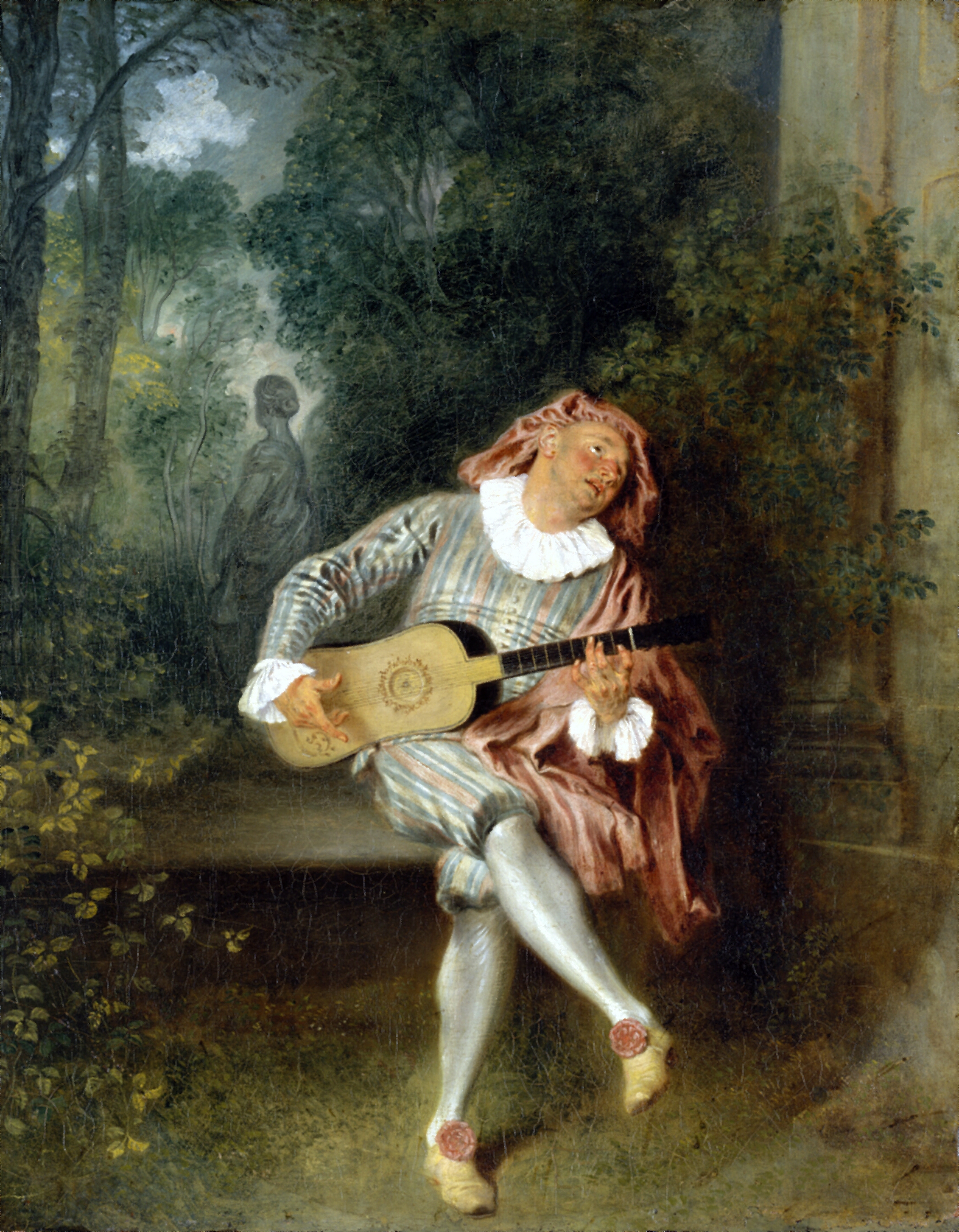
Watteau, Jean-Antoine
Boucher, François
| Boucher: Madame de Pompadour |
NAME SOME FAMOUS
HISTORICAL, SCIENTIFIC,
AND OR LITERARY HAPPENINGS
THAT TOOK PLACE DURING THIS
COMPOSER’S LIFETIME:
Stradivari, Antonio:


Violin Maker, 1700 (Cremona; Italy)
| Hammer Violin made by Antonio Stradivari |
Fahrenheit, Daniel Gabriel:
Fahrenheit Mercury
Thermometer, 1714
Franklin Stove, 1740

Piano, 1710
| Grand Piano, 1720 |
DESCRIBE WHAT YOU THINK
THIS COMPOSER’S OVERALL COMPOSITION
STYLE IS AND WHAT IS
DISTINCTIVE ABOUT IT.
THIS COMPOSER’S OVERALL COMPOSITION
STYLE IS AND WHAT IS
DISTINCTIVE ABOUT IT.
This music is from an era called the Baroque
(derived from the Italian barocco, meaning bizarre).
| An example of Baroque art http://thebloggerandhisshadow.blogspot.com/2009/10/baroque-art-beauty-or-beast.html |
The music style is highly elaborated and decorated with many
notes in layered melodies that create harmony: counterpoint.
Much of Bach’s music is written for keyboard (organ)
as he worked for the Church.
His music is very precise and
imbued with symmetry, so much
so that it is at times called mathematical.
WRITE YOUR PERSONAL OPINION
ABOUT THE MUSICAL STYLE OF
THIS COMPOSER AND EXPLAIN.
ABOUT THE MUSICAL STYLE OF
THIS COMPOSER AND EXPLAIN.
MISCELLANEOUS COMMENTS:
J. S. Bach Singing and Bio with Madlips
For nearly two hundred years there had
been organists and composers in the
Bach family. It was the family profession.
Bach was married twice. He had 7
children with his first wife who died
| Maria Barbara Bach |
and 13 with his second wife.
| Anna Magdalena Wilcke |
Many of his sons also became famous composers:
| Wilhelm Friedemann Bach c.1733 |
| Carl Philipp Emanuel Bach |
| Johann Christoph Friedrich Bach |
Painted by Thomas Gainsborough
1776
1776
Bach was employed by several courts (German kings and
princes) writing secular music for their private orchestras.
He was a church Cantor requiring him to write sacred, religious
music for the weekly services resulting in a prolific body of work.
All his music had to be copied by hand using a quill pen.
He often had his second wife, Anna Magdalena, help him with this
in the evenings by candlelight. At the time it was thought that the
strain on Bach’s eyes caused him to go blind by the end of his life.
Bach's reputation as a composer declined; his work was regarded
as old-fashioned compared to the emerging new classical style.
Almost 80 years after his death, the German composer and
conductor, Felix Mendelssohn,

arranged and conducted a performance of Bach’s music for a
concert in 1829.
His promotion and revival of the music helped make Bach one
of the most famous composers throughout all of music history.
Bach: A Passionate Life
Johann Sebastian Bach:
The Story of the Boy
who Sang in the Streets
from Stories of Great Composers for Children
By Thomas Tapper
Librivox Recording
https://www.youtube.com/watch?v=KDueycbXOu4
RAP BIOGRAPHY OF
JOHANN SEBASTIAN BACH
Labels:
Bach,
Bach composer report,
composer report,
general music
Subscribe to:
Posts (Atom)


.jpg)

.jpg)


.jpg)


.jpg)